

Learn why experience matters in personal injury cases, from proving liability to negotiating fair settlements and protecting your legal rights.
- Understanding Torts Law and the Foundations of Personal Injury Law
- Navigating Negligence and Strict Liability in Personal Injury Law Claims
- Intentional Harms, Property Torts, and Defamation
- Liability Allocation, Damages, and the Role of Legal Counsel
- Frequently Asked Questions about Personal Injury Law
- Conclusion
Understanding Torts Law and the Foundations of Personal Injury Law
Life is unpredictable, and unfortunately, accidents and injuries are an inherent part of the human experience. When these incidents arise from the actions or inactions of another, the legal system provides a framework for seeking justice and accountability: tort law. This intricate area of civil law is the cornerstone of personal injury claims, aiming to provide relief to those who have suffered harm. For individuals pursuing a personal injury claim, understanding how tort law applies can help clarify their legal options and the process for seeking compensation.
Understanding torts law is not merely an academic exercise; it’s vital for anyone who might find themselves, or a loved one, impacted by another’s wrongdoing. It governs a wide spectrum of civil wrongs, from simple negligence to intentional acts that cause injury.
In this comprehensive guide, we will demystify torts law, exploring its fundamental concepts and distinguishing it from criminal and contract law. We’ll break down the three primary categories of torts—intentional, negligence, and strict liability—and delve into their specific elements and applications. Our aim is to provide a clear understanding of how the legal system addresses civil wrongs, including the types of remedies available and the critical role of experienced legal representation in achieving fair outcomes. We’ll also examine the economic realities and policy goals that shape this ever-evolving field, helping you grasp its importance in our society. For those seeking detailed information on specific areas within this field, such as various Joel H. Schwartz Personal Injury Torts, understanding the core principles outlined here is a crucial first step.
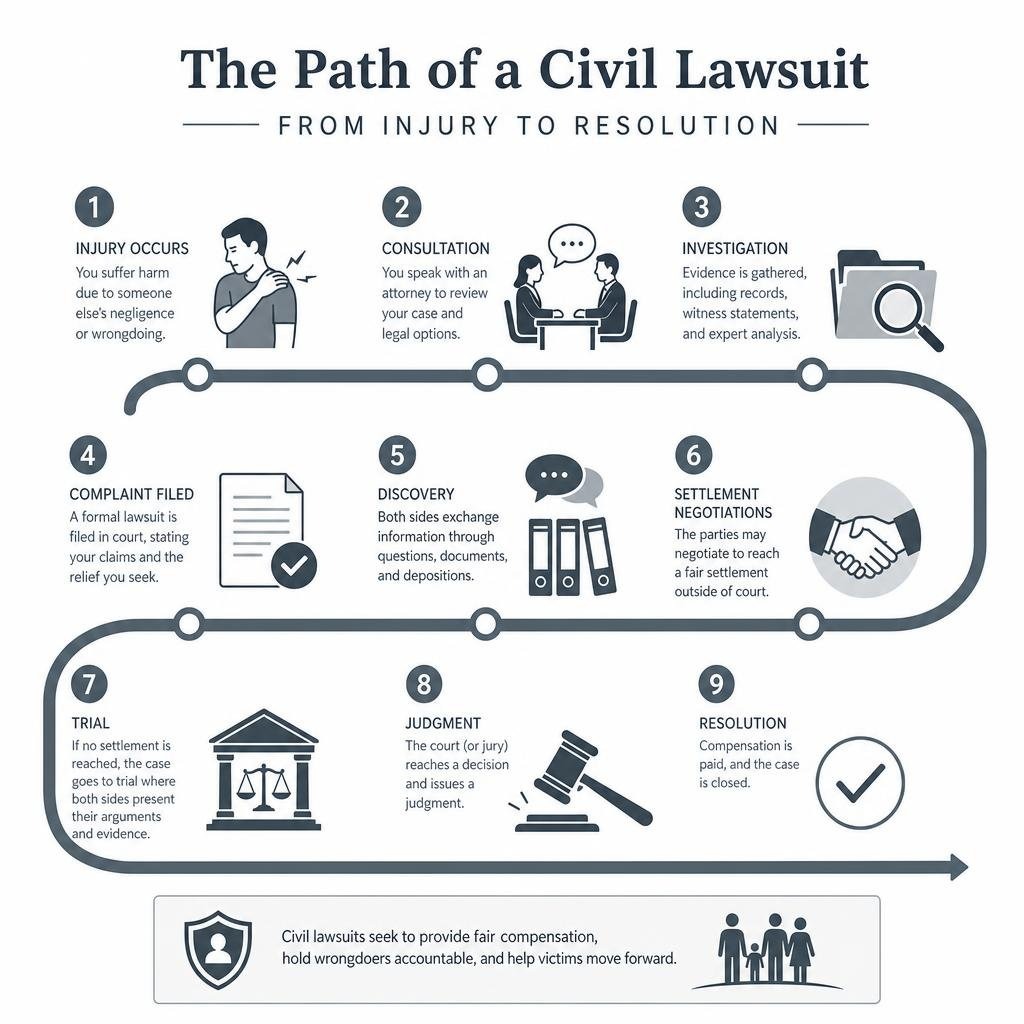
At its core, a tort is a civil wrong that causes a claimant to suffer loss or harm, resulting in legal liability for the individual who commits the tortious act. Unlike criminal law, which focuses on offenses against the state, or contract law, which deals with breaches of agreements, tort law addresses injuries and harms that arise outside of these specific contexts. It is fundamentally about providing relief to injured parties, assigning responsibility to those at fault, and discouraging harmful conduct.
The legal landscape of torts is primarily shaped by common law, which evolves through judicial decisions, and state statutory law. While specific rules can vary by jurisdiction, influential guides like the Restatement of Torts often serve to unify principles across different states. This body of law defines what constitutes a wrongful injury and offers victims a path to obtain court-ordered remedies from the wrongdoer.

Distinguishing Torts from Crimes and Contracts
To fully appreciate tort law, it’s crucial to understand how it differs from other branches of law:
- Torts vs. Crimes: While some actions, like battery, can lead to both tort and criminal liability, their purposes differ significantly. Criminal law aims to punish offenders and maintain public order, with the state prosecuting the case and seeking penalties like imprisonment or fines. Tort law, conversely, is about private wrongs, with the injured party (the plaintiff) seeking compensation from the wrongdoer (the defendant) to make them “whole” again. The standard of proof in criminal cases is “beyond a reasonable doubt,” whereas in tort cases, it’s the less stringent “preponderance of the evidence” (more probable than not).
- Torts vs. Contracts: Contract law deals with obligations voluntarily assumed through agreements. When a contract is breached, the remedy typically aims to enforce the contract or compensate for the benefit of the bargain lost. Tort law, however, addresses duties that are imposed by law, regardless of any agreement between the parties. For instance, we all have a legal duty not to negligently harm others, a duty that exists independently of any contractual relationship.
The Three Core Categories of Civil Wrongs
Tort law generally categorizes civil wrongs into three main types, each with distinct elements and implications:
- Intentional Torts: These occur when a person acts with the specific purpose of causing harm or knows with substantial certainty that their actions will cause harm. Examples include battery (intentional harmful or offensive contact), assault (intentional creation of apprehension of imminent harmful or offensive contact), and false imprisonment (unlawful restraint of a person’s movement). The focus here is on the defendant’s state of mind and their deliberate decision to engage in the conduct that led to the injury.
- Negligence: This is the most common type of tort and arises when a person fails to exercise the level of care that a reasonable person would have exercised in similar circumstances, leading to harm. Unlike intentional torts, negligence does not require a malicious intent to harm. Instead, it focuses on carelessness or a deviation from a reasonable standard of conduct. Common examples include car accidents caused by distracted driving or slip-and-fall incidents due to unaddressed hazards.
- Strict Liability: In certain situations, tort law imposes liability regardless of fault or intent. This means a defendant can be held responsible for harm even if they acted with utmost care and without any intention to cause injury. Strict liability is typically applied in cases involving abnormally dangerous activities (e.g., handling explosives), animal attacks (especially from wild animals or certain domestic breeds), and defective products. The underlying principle is that certain activities or products inherently carry a high risk, and those who engage in them or place them into the stream of commerce are best suited to bear the burden of any resulting loss.
These categories reflect tort law’s primary aims: to provide relief to injured parties, impose liability on responsible parties, and deter harmful acts by shifting the burden of loss from the injured party to the party at fault or better positioned to bear the loss.
Navigating Negligence and Strict Liability in Personal Injury Law Claims
The vast majority of personal injury claims fall under the umbrella of negligence. Understanding its elements is crucial for anyone involved in an accident or seeking to hold another party accountable for their actions. Strict liability, while less common, plays a vital role in areas like product safety.

Key Doctrines in Negligence Actions
A successful negligence claim typically requires proving four essential elements:
- Duty: The defendant owed a legal duty of care to the plaintiff. This generally means a duty to act as a reasonably prudent person would under similar circumstances. For instance, drivers owe a duty to other motorists and pedestrians to operate their vehicles safely.
- Breach: The defendant failed to meet that duty of care. This “breach of duty” occurs when the defendant’s conduct falls below the established standard of care. This is often an objective standard, asking what a “reasonable person” would have done, rather than what the defendant personally was capable of.
- Causation: The defendant’s breach of duty directly caused the plaintiff’s injuries. This element has two components:
- Factual Cause (Cause-in-Fact): Often determined by the “but-for” test – but for the defendant’s actions, the injury would not have occurred.
- Proximate Cause (Legal Cause): This limits liability to foreseeable consequences of the defendant’s actions. The famous Palsgraf principle established that a defendant is only liable for injuries to foreseeable plaintiffs within the zone of danger. Courts refuse to impose negligence liability for utterly unforeseeable injuries.
- Damages: The plaintiff suffered actual harm or injury that can be compensated by law. This can include physical injuries, emotional distress, medical expenses, lost wages, and pain and suffering.
Within negligence, several doctrines help clarify or modify these elements:
- Res Ipsa Loquitur (“the thing speaks for itself”): This doctrine allows a jury to infer negligence even without direct evidence of a defendant’s specific act of negligence. It applies when the accident is of a type that ordinarily does not occur in the absence of negligence, the instrumentality causing the injury was under the exclusive control of the defendant, and the plaintiff did not contribute to their own injury.
- Negligence Per Se: This doctrine simplifies the breach element when a defendant violates a statute or regulation designed to protect against the type of harm that occurred, and the plaintiff is within the class of people the statute was intended to protect. In such cases, the violation itself can establish a breach of duty.
- Foreseeability: A cornerstone of proximate cause, foreseeability determines whether the harm suffered by the plaintiff was a reasonably predictable outcome of the defendant’s negligent act.
- Objective Standard: As mentioned, the standard of care is objective, meaning individuals are held to the standard of a “reasonable person,” regardless of their individual capabilities or limitations. This ensures a consistent baseline for expected conduct.
Strict Liability and Products Liability Applications
Strict liability is a powerful tool in tort law because it removes the need to prove fault. It applies in specific contexts where the risk of harm is so great, or the public policy interest in safety is so high, that the responsible party should bear the cost of any injury, regardless of how careful they were.
- Abnormally Dangerous Activities: Activities like blasting, storing hazardous chemicals, or keeping wild animals are inherently dangerous. If these activities cause harm, the party conducting them may be held strictly liable.
- Products Liability: This is a significant area of strict liability, holding manufacturers and sellers responsible for injuries caused by defective products. Claims can arise under three main theories:
- Manufacturing Defects: Occur when a product deviates from its intended design, even if the design itself is safe. (e.g., a car with a faulty brake line due to an assembly error).
- Design Defects: Occur when the product’s design is inherently dangerous, even if manufactured perfectly. Courts often use a “risk-utility test” (balancing the product’s utility against the danger of its design) or a “consumer expectations test” (whether the product is more dangerous than an ordinary consumer would expect).
- Failure to Warn: Occurs when a product lacks adequate warnings or instructions about non-obvious dangers. (e.g., a medication without proper dosage instructions or side effect warnings).
In these cases, the focus shifts from the defendant’s conduct to the nature of the activity or the condition of the product. This approach ensures that consumers are protected from dangerous goods and that those who profit from high-risk ventures internalize the costs of potential harm.
Intentional Harms, Property Torts, and Defamation
Beyond negligence and strict liability, tort law also addresses harms that are intentionally inflicted, wrongs against property, and injuries to reputation or privacy. These categories highlight the diverse scope of civil wrongs recognized by the legal system.
Key Intentional Torts
Intentional torts require proof that the defendant acted with the purpose of causing the outcome or knew with substantial certainty that the outcome would occur. The plaintiff does not need to prove the defendant intended to cause injury, only that they intended the act.
- Battery: Involves intentional harmful or offensive physical contact with another person. The plaintiff does not need to be aware of the contact at the time it occurs (e.g., a surgeon operating on the wrong body part while the patient is under anesthesia).
- Assault: Occurs when a defendant intentionally places another person in reasonable apprehension of imminent harmful or offensive contact. No physical contact is necessary; the threat itself is the tort.
- False Imprisonment: The intentional unlawful confinement or restraint of a person against their will. This requires that the plaintiff be aware of the confinement or suffer harm from it.
- Intentional Infliction of Emotional Distress (IIED): Involves extreme and outrageous conduct by the defendant that intentionally or recklessly causes severe emotional distress to another. This is a high bar, requiring conduct that goes beyond mere insults or annoyances.
- Transferred Intent: A unique doctrine where the intent to commit one intentional tort against one person transfers if a different intentional tort is committed, or the intended tort is committed against a different person. For example, if someone intends to punch Person A but accidentally hits Person B, the intent to commit battery transfers to Person B.
Defenses to Intentional Torts: Common defenses include:
- Consent: If the plaintiff willingly agreed to the act.
- Self-Defense/Defense of Others: Using reasonable force to protect oneself or another from immediate harm.
- Defense of Property: Using reasonable force to protect one’s property, though deadly force is generally not permitted.
- Merchant’s Privilege: Allows a merchant to reasonably detain a suspected shoplifter for investigation.
Harms to Property and Economic Interests
Tort law also safeguards individuals’ rights concerning their property and economic well-being:
- Trespass to Land: The intentional physical invasion of another’s real property without permission. No actual harm to the land is required for the tort to occur.
- Trespass to Chattels: An intentional interference with another’s personal property (chattel) that causes minor damage or deprivation of use.
- Conversion: A more serious interference with personal property, where the defendant treats the plaintiff’s chattel as their own, effectively depriving the plaintiff of ownership. This often involves significant damage or permanent deprivation.
- Private Nuisance: An unreasonable and substantial interference with another’s use and enjoyment of their land (e.g., excessive noise, odors, or pollution from a neighboring property).
- Public Nuisance: An act that unreasonably interferes with a right common to the general public (e.g., blocking a public road or polluting a public water source).
- Tortious Interference: Involves intentionally interfering with another’s contractual or business relationships, causing economic harm.
Defamation and Privacy Violations in Personal Injury Law
These torts protect an individual’s reputation and their right to be left alone:
- Defamation: The publication of a false statement of fact about another that harms their reputation.
- Libel: Written defamation.
- Slander: Spoken defamation. To succeed in a defamation claim, the plaintiff generally must prove the statement was false, published to a third party, caused harm to reputation, and was made with the requisite level of fault.
- Invasion of Privacy: This is a group of distinct torts, including:
- Intrusion upon Seclusion: Highly offensive invasion of a person’s private affairs.
- Appropriation of Likeness: Unauthorized use of a person’s name or image for commercial gain.
- Public Disclosure of Private Facts: Publicizing private information that is highly offensive and not of legitimate public concern.
- False Light: Publicizing information that places a person in a false and offensive light before the public.
Constitutional Standards: For defamation and false light claims involving public figures or matters of public concern, constitutional standards apply. Public figures (e.g., politicians, celebrities) must prove “actual malice”—that the defendant knew the statement was false or acted with reckless disregard for its truth or falsity—a higher standard than for private individuals. These standards reflect a balance between protecting individual reputation and upholding freedom of speech and the press.
Liability Allocation, Damages, and the Role of Legal Counsel
When multiple parties are involved in causing harm, or when a plaintiff contributes to their own injury, tort law provides mechanisms for allocating responsibility. Furthermore, understanding the types of damages available is key to achieving fair compensation.
Apportioning Fault Among Multiple Parties
In many personal injury cases, more than one party may bear some responsibility for the harm. Courts use various rules to apportion fault:
- Comparative Fault (or Comparative Negligence): This is the most common approach today. It reduces the plaintiff’s recovery by the percentage of fault attributed to them. For example, if a jury finds a plaintiff 20% at fault for an accident and awards $100,000 in damages, the plaintiff would receive $80,000.
- Pure Comparative Fault: Allows a plaintiff to recover damages even if they are mostly at fault (e.g., 90% at fault, still recovers 10% of damages).
- Modified Comparative Fault: This is what many states, including Massachusetts, follow. It allows recovery only if the plaintiff’s fault is below a certain threshold, typically 50% or 51%. For instance, under a “51 percent Bar Rule,” if the plaintiff is found 51% or more at fault, they recover nothing. If they are 50% or less at fault, their damages are reduced proportionally.
- Contributory Negligence: A historical and now rare approach where if a plaintiff was found even 1% at fault, they were completely barred from recovering any damages. Only a handful of states and D.C. still use this strict rule.
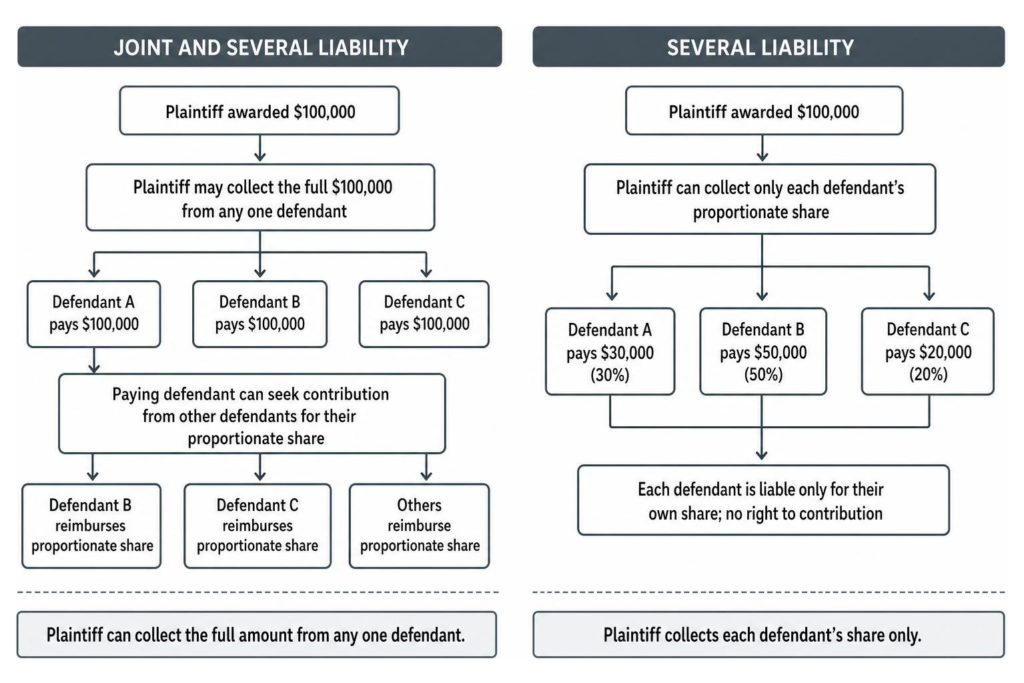
- Joint and Several Liability: When multiple defendants are found liable, this rule allows an injured plaintiff to collect the full amount of damages from any one of the defendants, regardless of their individual percentage of fault. The defendant who pays the full amount can then seek “contribution” from the other liable defendants to recover their proportionate share.
- Contribution: The right of a tortfeasor who has paid more than their share of damages to recover the excess from other tortfeasors.
Vicarious Liability and Systemic Challenges
Sometimes, one party can be held liable for the tortious acts of another, even if they weren’t directly involved:
- Vicarious Liability: This legal doctrine imposes liability on a person for the tortious acts of another. The most common example is employer liability for the actions of their employees under the principle of respondeat superior (“let the master answer”). An employer can be held liable for an employee’s negligence or intentional torts committed within the scope of employment.
- Independent Contractors: Generally, a hiring party is not vicariously liable for the torts of independent contractors, as they do not control the manner and means of the contractor’s work. However, exceptions exist, particularly for inherently dangerous activities or if the hiring party retains significant control over the work.
While tort law aims to provide justice, the system faces ongoing scrutiny regarding its costs, effectiveness, and potential for reform. Tort inflation, driven by factors such as societal views, extensive trial lawyer advertising, and the rise of third-party litigation funding, has led to significant economic burdens. For example, the U.S. tort system cost approximately $443 billion in 2020, representing 2.1% of the national GDP. Small businesses, despite accounting for only 20% of commercial revenues, bear a disproportionate 48% of commercial tort costs. Furthermore, statistics indicate that only about 53 cents of every dollar in the U.S. tort system actually reach victims, with the remaining 47% going to litigation costs and expenses. Mass tort litigation, involving numerous plaintiffs against a single defendant (often in product liability or toxic tort cases), can overwhelm businesses and sometimes result in claimants receiving less due to high legal fees. These challenges highlight the ongoing debate about balancing victim compensation with economic efficiency and fairness.
Remedies Available in Tort Cases
The primary goal of tort law is to make the injured party whole through various forms of damages:
- Compensatory Damages: Intended to compensate the plaintiff for their losses. These are divided into:
- Special Compensatory Damages (Economic Damages): Quantifiable monetary losses, such as medical expenses (past and future), lost wages (past and future), property damage, and other out-of-pocket expenses.
- General Compensatory Damages (Non-Economic Damages): Non-monetary losses that are harder to quantify, such as pain and suffering, emotional distress, loss of enjoyment of life, and loss of consortium (loss of companionship or services from a spouse or family member).
- Punitive Damages (Exemplary Damages): These are not intended to compensate the plaintiff but rather to punish the defendant for particularly egregious conduct and deter similar behavior in the future. Punitive damages are awarded only in cases involving malice, fraud, oppression, or gross negligence that demonstrates a reckless disregard for the rights of others. Many states have caps on punitive damages, and they are generally rare outside the United States.
- Injunctive Relief: In some cases, a court may issue an injunction, which is a court order requiring a defendant to do something (e.g., stop a nuisance) or refrain from doing something (e.g., cease a harmful activity). This is less common in personal injury cases but can be crucial in certain property or environmental torts.
Frequently Asked Questions about Personal Injury Law
Navigating the complexities of personal injury law can be challenging. Here, we address some common questions to provide further clarity.
What is the difference between special and general compensatory damages?
Special compensatory damages, also known as economic damages, cover quantifiable financial losses directly resulting from the injury. This includes medical bills (hospital stays, doctor visits, medication, therapy), lost wages or earning capacity, property damage, and other out-of-pocket expenses. These are often proven with receipts, invoices, and employment records.
General compensatory damages, or non-economic damages, cover subjective, non-monetary losses that are harder to assign a precise dollar value. These include pain and suffering (physical discomfort and emotional distress), mental anguish, loss of enjoyment of life, disfigurement, and loss of consortium. While difficult to quantify, these damages are a crucial part of making an injured person whole, as they address the profound impact an injury can have on quality of life.
How does the modified comparative fault rule affect financial recovery?
The modified comparative fault rule, which many states including Massachusetts follow, allows an injured plaintiff to recover damages even if they were partially at fault for the accident, but only up to a certain point. Typically, this threshold is 50% or 51%. If a plaintiff is found to be 50% or less at fault, their total awarded damages will be reduced by their percentage of fault. For example, if a jury awards $100,000 but finds the plaintiff 20% at fault, the plaintiff would receive $80,000. However, if the plaintiff is found to be 51% or more at fault, they are completely barred from recovering any damages from the other party. This “51 percent Bar Rule” is a significant factor in determining potential recovery in personal injury claims.
When can a plaintiff seek punitive damages in a civil lawsuit?
Punitive damages are awarded in a civil lawsuit not to compensate the plaintiff for their losses, but to punish the defendant for particularly egregious conduct and to deter similar behavior by others. They are typically reserved for cases where the defendant’s actions demonstrate malice, fraud, oppression, or a reckless disregard for the safety and rights of others. This often involves conduct that is considered willful, wanton, or grossly negligent. Punitive damages are rare, and their availability varies significantly by state law. Some states have caps on the amount of punitive damages that can be awarded, or specific conditions under which they can be sought. For instance, in Massachusetts, punitive damages are generally limited to wrongful death cases involving gross negligence or certain employment discrimination lawsuits.
Conclusion
Torts law is a dynamic and essential field that underpins personal injury claims, offering a crucial pathway for individuals to seek justice and compensation when harmed by the actions of others. From intentional acts to careless mistakes and even liability without fault, the principles of duty, breach, causation, and damages provide a framework for determining responsibility. The system aims to provide civil recourse, ensuring legal accountability and promoting risk mitigation across society.
However, the complexities of liability allocation, the nuances of damage calculations, and the broader systemic challenges within the tort system underscore the importance of experienced legal representation. Navigating these intricate legal waters requires a deep understanding of common law, statutory provisions, and procedural rules. For those who have suffered an injury, understanding these fundamentals is the first step toward advocating for their rights and securing the fair outcome they deserve. We work on a contingency fee agreement which means we only get paid if we win your case. We take on all the risk and you never have to pay us anything out of your pocket. We get paid when you get paid at the end of your case.