

Learn how partial fault can affect your car accident claim, compensation, liability, and the legal steps that may help protect your rights.
- Why Shared Blame Matters
- What Partial Fault Usually Means
- How Percentages Affect Payment
- Evidence Drives the Outcome
- Common Situations That Raise Shared Fault
- Insurance Companies Use Partial Fault Hard
- Steps That Help Protect a Claim
- Missouri’s Rule Matters
- Damages Still Need Proof
- When a Case Becomes More Complex
- Small Facts Can Shift Fault
- Understanding How Shared Fault Can Shape Your Recovery
After a car accident, many injured people worry that admitting even a minor mistake could cost them the financial recovery they need for medical care, lost income, and other losses. Understanding how St. Louis car accident lawyers evaluate shared responsibility can help clarify why fault is rarely decided by a single statement, photograph, or police report alone. Instead, the outcome often depends on how the available evidence fits together and whether it presents a complete picture of the events leading up to the collision.
This issue carries particular importance in Missouri, where the law allows injured people to pursue compensation even if they bear part of the responsibility for the crash. That legal approach places considerable attention on how fault percentages get argued, documented, and supported throughout the claims process. Even details that appear minor immediately after an accident may later influence negotiations with insurers or courtroom arguments. Knowing how shared fault works before important decisions happen can help injured people protect their rights while avoiding statements or actions that may unfairly increase their share of responsibility.
Why Shared Blame Matters
Fault rules differ by state, which means claim value can change quickly after a few misplaced words. Missouri allows the division of blame between several people, which is why many injured drivers consult car accident lawyers soon after a wreck. Strong proof often decides whether someone appears cautious, careless, or partly responsible during insurance discussions or trial.
What Partial Fault Usually Means
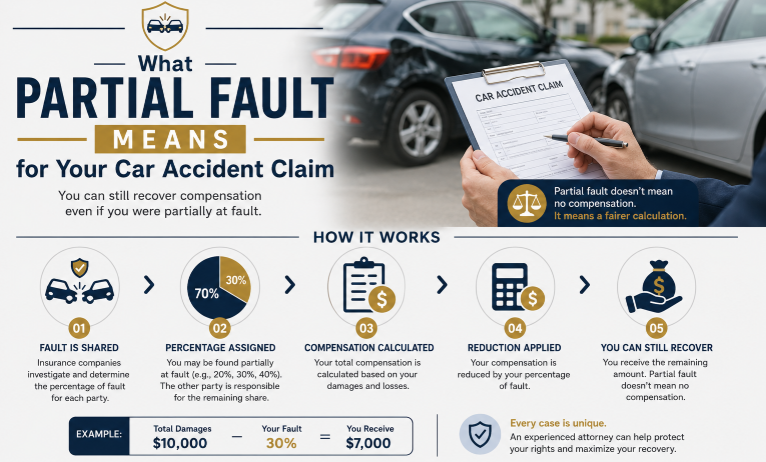
Partial fault means two or more actions helped cause the crash. A driver may tailgate, while another turns without enough room. Each act can receive a percentage after the facts get reviewed. Adjusters, judges, or jurors may assign those shares. That figure then reduces the money an injured person can recover for medical costs, lost pay, vehicle damage, and pain.
How Percentages Affect Payment
The reduction usually matches the assigned share of blame. If losses total $100,000 and the injured driver carries 20 percent fault, recovery may fall to $80,000. The arithmetic looks simple on paper. The real dispute sits inside the percentage itself. A modest shift, from 20 percent to 35 percent, can erase a substantial part of the claim’s value.
Evidence Drives the Outcome
Fault findings rest on proof, not instinct. Police reports, scene photographs, repair estimates, camera footage, and witness accounts help show how the impact happened. Medical records also matter because they connect bodily harm to the collision. Timing also matters. When evidence disappears, the opposing side has more room to argue that the injured person caused a larger share of the event.
Common Situations That Raise Shared Fault
Rear-end crashes can still involve shared blame if the front vehicle stops without a clear reason. Left-turn wrecks often raise issues about speed, signals, and sight lines. Multi-car collisions create even more dispute. Rain, fog, or ice can affect visibility and stopping distance. Those conditions do not excuse careless conduct, yet they can change the division of blame between the people involved.
Insurance Companies Use Partial Fault Hard
Insurers often raise shared fault early because it reduces what they may owe. An adjuster may focus on one missed signal, one delayed brake, or one brief distraction. That approach can work if the injured person speaks too freely. A recorded statement given soon after the crash may leave gaps. Later, insurers can use those gaps to support a higher blame percentage.
Steps That Help Protect a Claim
Strong claims usually begin with practical steps. People should get medical care, report the wreck, photograph the scene, and keep records for repairs and treatment. It also helps to avoid broad comments about blame at the roadside. Even polite remarks can get twisted later. Clear notes made on the first day make it harder for an insurer to reshape the sequence of events.
Missouri’s Rule Matters
Missouri follows pure comparative fault. That rule allows an injured person to recover damages even with substantial blame, though the award drops by that same percentage. A driver who is 70 percent at fault may still recover 30 percent of proven losses. The rule aims for fairness. At the same time, it makes fault allocation the central dispute in many car accident claims.
Damages Still Need Proof
Shared fault does not remove the need to prove damages. Medical bills, missed wages, future care, and pain still need support. Without records, even a favorable fault split may not save a weak case. Courts and insurers look for a clear connection between the crash and the harm claimed. Solid documentation gives those losses a reliable, persuasive foundation.
When a Case Becomes More Complex
Some claims carry extra layers that affect blame. Commercial vehicle cases may involve company policies, driver logs, and maintenance history. Intersection crashes may require signal timing data or expert reconstruction. A road defect can bring a public agency into the dispute. Each added party creates new arguments about who acted carelessly, and how much that conduct contributed to the collision.
Small Facts Can Shift Fault
A turn signal used a few seconds late may matter. Tire marks, phone records, and seat position can matter too. At first glance, those details may seem minor. Later, they can alter the entire account of how the crash unfolded.
Understanding How Shared Fault Can Shape Your Recovery
Partial fault does not end a car accident claim, but it can change the result in meaningful ways. The amount recovered, the evidence needed, and the strategy used all turn on the assignment of blame. Minor details often carry large financial effects. Prompt treatment, careful records, and measured statements can protect a claim from unfair fault arguments. In many cases, the strongest position belongs to the person who preserves the facts first.