
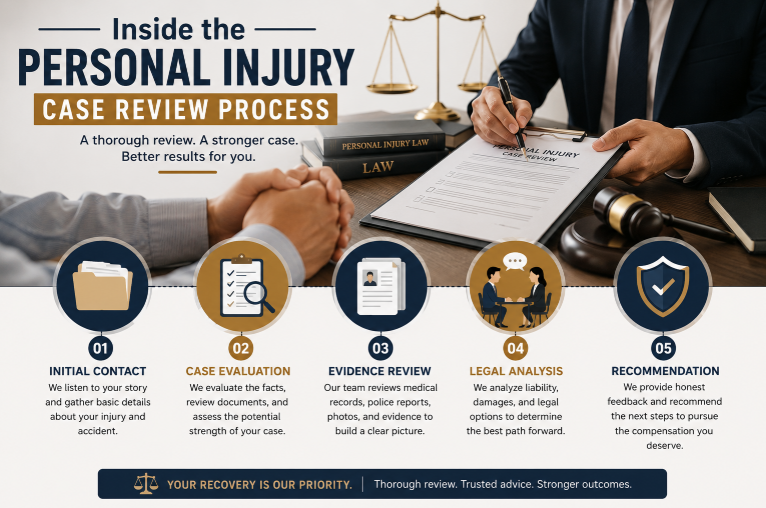

Learn what happens during a personal injury case review, how attorneys assess evidence, determine liability, and build a strong claim.
After a serious accident, many people focus on medical treatment and financial concerns without realizing how much a detailed legal review can influence the path ahead. DeHoyos Accident Attorneys often explain that a thorough evaluation begins long before settlement discussions, examining how the incident occurred, what evidence is available, and whether the facts support a claim under the law. Looking closely at those details early can reveal missing records, conflicting accounts, or deadlines that deserve immediate attention before external parties begin shaping the narrative. This process also helps connect injuries, medical care, lost income, and other consequences into a factual timeline that reflects what happened and how it changed daily life.
These issues are especially relevant across Houston, Pearland, League City, and Victoria, TX, where heavily traveled roads, expanding neighborhoods, and active business districts contribute to a wide range of incidents that leave people facing physical, emotional, and financial challenges. Understanding what happens during an initial legal review allows injured individuals to gather stronger documentation, ask informed questions, and make thoughtful decisions before placing important legal rights or evidence at risk.
First Legal Screening
A serious claim starts with fault, injury, proof, and timing. Police reports, treatment notes, photos, witness names, and policy details create the first working picture. Trusted accident attorneys appear in this context because early legal screening often reveals claim value, missing records, insurance barriers, and urgent filing dates before settlement discussions begin.
Incident Facts
The reviewer reconstructs what happened minute by minute. Location, lighting, surface conditions, traffic signals, speed, warnings, and witness positions all matter. Minor timing gaps can damage credibility later. A clear factual record helps separate reliable evidence from memory, assumption, or insurer interpretation.
Liability Review
Liability turns on duty, breach, and harm. A driver may have ignored distance. A store may have left liquid on tile. A contractor may have skipped safety steps. The review also checks shared fault, because partial responsibility can reduce payment in many states.
Medical Proof
Medical proof links trauma to diagnosis. Emergency notes, imaging, prescriptions, therapy records, surgical reports, and specialist opinions show severity and progression. Treatment gaps invite questions. A careful review looks at symptom patterns, physical limits, clinical findings, and whether future care, injections, surgery, or rehabilitation may be likely.
Damages Count
Losses reach beyond invoices. Wage records, tax forms, mileage logs, pharmacy receipts, home care costs, and provider statements can support financial harm. Pain, sleep disruption, anxiety, weakness, stiffness, and reduced mobility also matter. Strong damages work turns daily hardship into organized proof.
Insurance Layers
Coverage often controls practical recovery. The review identifies liability limits, uninsured motorist benefits, commercial policies, umbrella coverage, and health plan liens. Policy terms may affect payment order. Even a strong claim needs a collectible source, so coverage analysis should happen early.
Evidence Strength
Independent proof carries weight. Camera footage, crash data, repair estimates, maintenance logs, inspection records, scene photographs, and neutral witnesses can confirm disputed facts. Some material disappears quickly. Preservation letters may protect video, digital files, vehicle data, or business records before routine deletion occurs.
Credibility Factors
Insurers compare every statement. They may check medical histories, recorded calls, social posts, employment records, and prior claims for inconsistencies. Real injuries can lose value when explanations shift. Early review finds weak points, adds context, and prepares the file before an adjuster frames the story.
Deadline Checks
Timing can decide whether rights survive. Statute of limitations, notice rules, government claim dates, and insurance reporting terms require close attention. One missed deadline can end recovery. A reliable review creates a calendar, confirms jurisdiction, and records each notice with delivery proof.
Settlement Value
Case value usually begins as a range. Liability strength, injury severity, treatment length, recovery outlook, venue, policy limits, and comparable outcomes all influence that range. This approach helps reject low early offers while keeping expectations tied to evidence, not hope.
Litigation Readiness
Some claims resolve through negotiation. Others need filing, discovery, depositions, medical experts, or trial preparation. Litigation readiness asks whether records are complete, witnesses remain available, and opinions can support causation. A well-prepared file often improves settlement pressure because the claim can move forward without delay.
Client Fit
Practical fit matters. Medical progress, communication needs, financial stress, work limits, and risk tolerance can shape strategy. Lawyers need accurate facts. Injured clients need clear expectations. When both sides share reliable information, choices about settlement, filing, and long-term costs become easier.
Building a Strong Foundation Before Moving Forward
A thorough personal injury review gives structure to a painful, uncertain period. It tests fault, connects medical proof, measures losses, checks coverage, preserves evidence, and protects deadlines. That process helps you see strengths and risks before major decisions arise. No evaluation can promise a result. Still, organized records, steady treatment, and clear communication can prevent avoidable mistakes and support better choices from the start.