
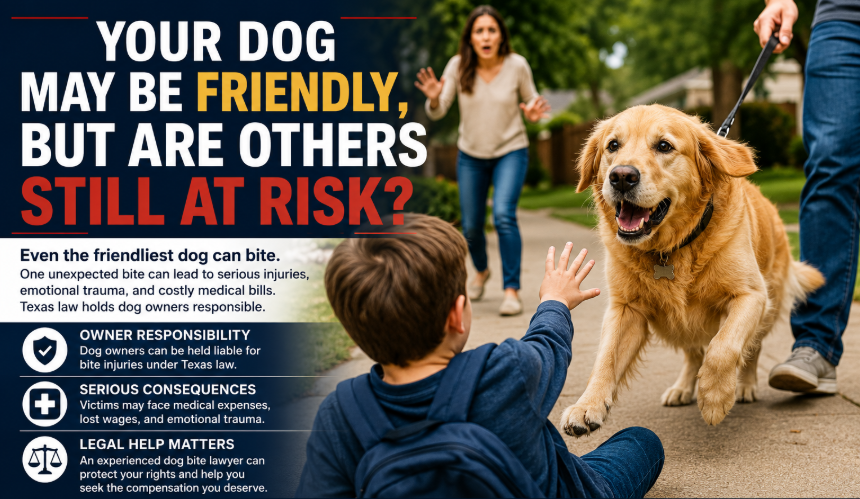

Most dog owners see a side of their pet that other people never see. At home, the dog may be gentle, affectionate, and playful. It may sleep beside the children, greet family members at the door, and never show any obvious signs of aggression.
- Any Dog Can Bite Under the Wrong Circumstances
- Pay Attention to the Warning Signs
- Children Need Close Supervision Around Dogs
- Prepare Before Guests Enter Your Home
- Protect Delivery Drivers and Service Workers
- Use Leashes, Fences, and Training Consistently
- Take Growling, Snapping, and Previous Incidents Seriously
- Texas Owners May Face Special Requirements for Dangerous Dogs
- Being Careful Does Not Mean You Distrust Your Dog
- What Should Someone Do After a Dog Bite?
That history matters, but it does not guarantee that the dog will react the same way in every situation.
A friendly dog can become frightened, startled, protective, sick, or overwhelmed. An unfamiliar visitor, a running child, a delivery driver, or another animal may trigger a reaction the owner has never seen before. Responsible dog ownership means recognizing those risks before someone gets hurt.
Any Dog Can Bite Under the Wrong Circumstances
Dogs do not usually bite without a reason. However, people may not recognize the reason until it is too late.
A dog may react defensively when it is:
- Eating or protecting a favorite toy
- Sleeping or suddenly awakened
- Injured, sick, or in pain
- Caring for puppies
- Frightened by loud noises or sudden movement
- Cornered or unable to move away
- Protecting its home, yard, or owner
- Overwhelmed by children or unfamiliar guests
The Centers for Disease Control and Prevention warns that any dog can bite, especially when it is nervous, frightened, eating, playing, protecting something, or not feeling well. The CDC also reports that nearly one in five people bitten by a dog requires medical attention.
The issue is not whether your dog is “good” or “bad.” The real question is whether the dog could feel threatened or overstimulated in a particular situation.
Pay Attention to the Warning Signs
Dogs often communicate discomfort before they bite. Unfortunately, owners sometimes dismiss those signals because the dog has never attacked anyone.
Warning signs may include:
- Growling
- Showing teeth
- Snapping without making contact
- Stiffening the body
- Raising the hair along the back
- Pinning the ears back
- Tucking the tail
- Staring intensely
- Moving away or hiding
- Repeatedly licking the lips or yawning
- Guarding food, toys, furniture, or a person
A growl should not be treated as meaningless or punished without addressing the cause. It is often a warning that the dog feels unsafe and needs space.
Owners should separate the dog from the situation and speak with a veterinarian or qualified dog behavior professional. Pain, illness, fear, poor socialization, and anxiety can all contribute to unexpected behavior.
Children Need Close Supervision Around Dogs
Children are especially vulnerable because they may not understand a dog’s signals. A child may hug the dog tightly, pull its tail, approach its food, or place their face close to the dog’s face.
Even a patient dog may react when it feels trapped or hurt.
The CDC advises that young children should never be allowed to play with dogs without adult supervision, even when the child knows the dog and the animal is a trusted family pet. Many bites involving young children happen during ordinary activities with familiar dogs.
Supervision requires more than being somewhere in the same room. An adult should be close enough to step in immediately.
Teach children to:
- Leave dogs alone while they are eating or sleeping
- Avoid climbing on, hugging, or chasing a dog
- Ask permission before petting someone else’s dog
- Allow an unfamiliar dog to approach first
- Stop interacting when a dog moves away
- Never tease a dog through a fence
When active supervision is not possible, the safest choice is to separate the dog and child.
Prepare Before Guests Enter Your Home
A dog that is calm around family members may behave differently when strangers enter its space.
Before opening the door, place the dog behind a secure gate, in another room, or in a properly designed crate. Do not assume that holding the dog by its collar will be enough. A strong or frightened dog can pull away quickly.
Tell guests how to behave around the dog. Do not pressure someone to pet the animal or insist that “he just wants to smell you.” Some guests may be afraid of dogs, have mobility limitations, or make movements the dog does not understand.
When children visit, separation may be the safest option, especially if the dog has not spent much time around young children.
Protect Delivery Drivers and Service Workers
Delivery drivers, postal workers, utility employees, landscapers, and repair technicians frequently enter areas that dogs consider part of their territory.
A closed gate is not enough if it can be pushed open, jumped over, or left unsecured. Before a worker arrives:
- Bring the dog inside.
- Place it in a secure room or enclosure.
- Check that gates and fences are locked.
- Tell the worker that a dog is present.
- Keep the dog restrained until the worker has left.
Do not open the front door while an unrestrained dog is standing beside you. A dog can slip through the doorway in seconds, even if it has never done so before.
Use Leashes, Fences, and Training Consistently
Responsible owners should not rely only on verbal commands. Even a well-trained dog can ignore a command when frightened or excited.
Use a properly fitted leash whenever the dog is in a public place. Regularly inspect fences, gates, latches, and kennels for damage. Make sure children cannot open the gate without supervision.
The CDC identifies socialization and leash use in public as important parts of preventing dog bites. It also recommends fencing yards to reduce unwanted contact between dogs and strangers.
Training should focus on calm, controlled behavior rather than aggression. Owners should also maintain regular veterinary care because pain or illness can cause changes in a dog’s temperament.
Take Growling, Snapping, and Previous Incidents Seriously
A dog does not have to break the skin for an incident to be important.
If the dog lunges, snaps, knocks someone down, escapes its enclosure, or behaves aggressively near another person, treat the event as a warning. Do not explain it away because no one was injured.
Document what happened and consider:
- What was occurring immediately before the reaction?
- Was the dog frightened, protecting something, or in pain?
- Has similar behavior happened before?
- Does the dog need a more secure enclosure?
- Should the dog be kept away from children or guests?
- Is professional training or veterinary care needed?
Acting after a warning may prevent a much more serious event later.
Texas Owners May Face Special Requirements for Dangerous Dogs
Texas law places specific requirements on owners after a dog is legally considered dangerous. Under Chapter 822 of the Texas Health and Safety Code, the owner may be required to register the dog, keep it on a leash under immediate control or in a secure enclosure, obtain at least $100,000 in liability coverage or establish financial responsibility, and follow additional local restrictions.
Cities and counties may also have their own leash, restraint, registration, and dangerous-dog ordinances. Owners should check the rules where they live rather than assuming the same requirements apply everywhere in Texas.
More importantly, owners should not wait for a legal designation or serious injury before taking precautions.
Being Careful Does Not Mean You Distrust Your Dog
Many dog bites can be prevented through supervision, secure restraint, proper training, veterinary care, and respect for a dog’s boundaries.
Taking precautions does not mean you believe your dog is vicious. It means you understand that dogs are animals with instincts, fears, and limits.
Your dog may be loving and friendly. Responsible ownership means making sure others remain safe even on the day your dog becomes frightened, injured, protective, or overwhelmed.
What Should Someone Do After a Dog Bite?
A person bitten by a dog should wash the wound thoroughly, seek medical care when appropriate, identify the dog and its owner, obtain vaccination information, photograph the injuries, and report the incident to local animal control. Deep wounds, uncontrolled bleeding, signs of infection, or uncertainty about rabies vaccination require prompt medical attention.
A serious dog attack can leave a victim with medical bills, scarring, emotional trauma, and time away from work. Anyone injured because a dog was not properly controlled should consider speaking with an experienced Texas dog bite lawyer about their rights.