
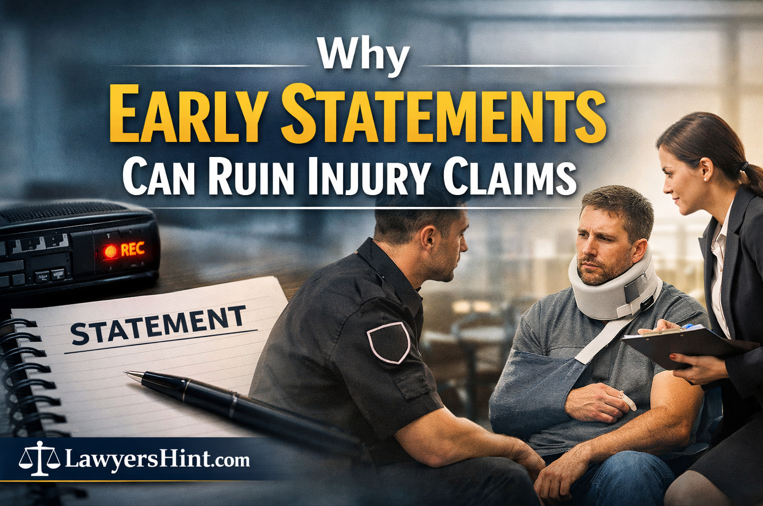

Early statements can shape the outcome of a case. Learn why accuracy, timing, and legal guidance matter when giving your first statement.
- Why Early Statements Matter More Than Most People Think
- How Recorded Statements Can Be Used Later
- The Problem With Trying to Sound Reasonable
- Why Medical Timing Changes the Conversation
- What Insurance Adjusters Are Listening For
- How Accident Victims Can Protect Themselves
- A Better Way to Handle the First Few Days
After an accident, most people are not thinking like insurance companies think. They are thinking about pain, repairs, missed work, and how to get through the next few days without everything spiraling. In that state, a simple phone call can feel harmless. The adjuster sounds calm, asks a few questions, and makes it seem like all they need is your side of the story so the claim can move forward.
But early statements often carry more weight than people realize. What you say in those first conversations can shape how your injuries are viewed, how fault is discussed, and how much resistance you face later. A few rushed words, a guess about what happened, or an attempt to sound polite can end up becoming part of the insurer’s strategy. Understanding how this works can help accident victims avoid mistakes that quietly weaken otherwise valid claims.
Why Early Statements Matter More Than Most People Think
Insurance companies move quickly because early conversations are useful to them. Before you have seen all your records, before delayed pain fully appears, and before you have had time to reflect on the accident, you are more likely to speak casually and leave room for interpretation. That is one reason many people seek guidance from the Law Offices of Adrianos Facchetti before agreeing to recorded calls or detailed discussions with an adjuster.
An early statement can shape the file from the start. If you say you are “fine” because you are still in shock, that may later be used to question why you sought treatment. If you estimate speed, distance, or reaction time without really knowing, those guesses can be repeated as if they were facts. In many cases, the issue is not that someone lied. It is that they spoke too soon, before they had enough information to speak carefully.
How Recorded Statements Can Be Used Later
A recorded statement is often presented as routine. The adjuster may say it is just part of the process or that they need it to move things forward. What many people do not realize is that recordings create a fixed version of events that can be revisited whenever a dispute comes up.
If details later change because more evidence comes in, the insurer may focus on the inconsistency rather than the reason for it. If your injuries become more serious over time, they may compare your early description to later medical findings and argue that you are exaggerating. Even small wording choices can matter. Saying “I didn’t really feel hurt at first” may sound innocent, but it can become a point of attack if treatment becomes extensive.
This is why many attorneys advise accident victims to be cautious before agreeing to anything recorded. It is not about hiding facts. It is about making sure the facts are clear before you lock yourself into a version of events that may be incomplete.
The Problem With Trying to Sound Reasonable
A lot of people hurt their own claims because they are trying to sound fair, calm, or cooperative. They do not want to come across as dramatic, and they certainly do not want to seem like they are chasing money. So they downplay pain, apologize at the scene, or say things like “maybe I could have stopped sooner.”
Insurance companies know this happens, and they often benefit from it. A person trying to be polite may give away far more than they mean to. Once that happens, the focus shifts. Instead of the claim being about the full facts of the accident, it starts becoming about statements the injured person made while stressed, confused, or still running on adrenaline.
Being careful is not the same as being difficult. Sticking to facts, avoiding speculation, and waiting until you understand your injuries more clearly is often the smarter and more honest approach.
Why Medical Timing Changes the Conversation
One of the biggest problems with early statements is that injuries do not always show themselves right away. A person may walk away from a crash thinking they escaped with a few aches, only to wake up the next day with severe neck pain, headaches, or dizziness. Soft tissue injuries, back problems, and concussion symptoms often become clearer over time.
If the insurance company speaks with you before that happens, they may treat your first impression of your condition as the most reliable one. That can create unnecessary friction later, even when your medical records support the seriousness of the injury. This is why prompt medical care matters. It not only helps with treatment, but also creates a timeline that ties symptoms to the accident before the insurer has too much room to question them.
What Insurance Adjusters Are Listening For
Adjusters are not just collecting facts. They are listening for weaknesses. They pay attention to uncertainty about fault, vague injury descriptions, comments that suggest prior pain, and anything that can later support a lower payout. If they hear hesitation, inconsistency, or gaps, those things may quietly shape how the claim is valued.
That does not mean every adjuster is acting in bad faith. It means their job is to evaluate risk and control cost. From that perspective, an early statement is useful because it gives them material before a claim is fully developed. The less complete your picture is, the easier it is for them to define it for you.
How Accident Victims Can Protect Themselves
The safest way to approach early insurance contact is with patience and clarity. You do not need to answer every question immediately, and you do not need to speculate when you are unsure. If you are still being evaluated, still in pain, or still gathering information, it is reasonable to say so.
It also helps to document things early. Photos, medical visits, work disruptions, and written notes about symptoms can all create a stronger, more accurate record than memory alone. The more grounded your claim is in real documentation, the less power an incomplete early statement has over the outcome.
A Better Way to Handle the First Few Days
The first days after an accident are often messy, emotional, and full of pressure to move quickly. That is exactly why early statements can be so risky. Insurance companies know that people speak differently when they are overwhelmed. They know that pain evolves, memories sharpen or fade, and small comments can later be isolated from their original context.
A little caution in that early period can protect far more than most people realize. Taking time to get checked out, gather information, and understand the situation before speaking in detail often leads to a more accurate and fairer claim process. For accident victims, that can mean less confusion, fewer avoidable setbacks, and a stronger position when it matters most.