
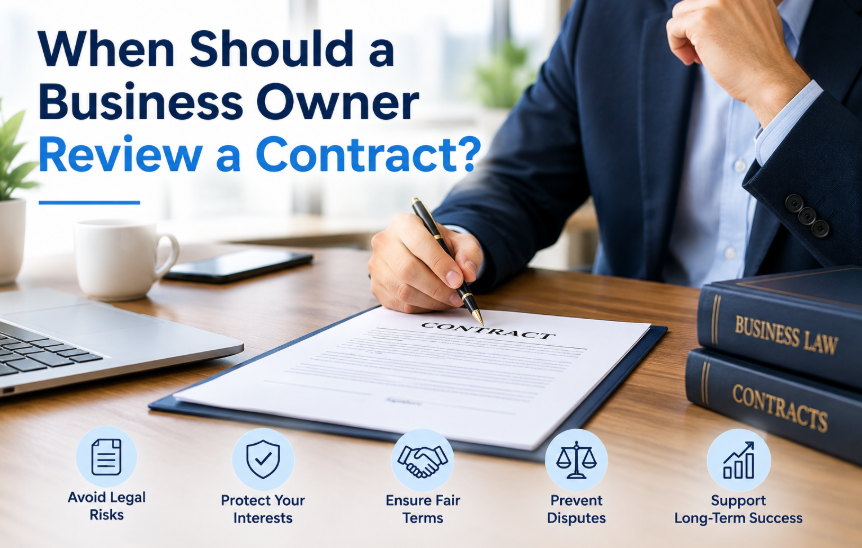

Business contracts can shape your costs for several years. A short review before signing may expose obligations you missed completely.
- 1. The Contract Involves Significant Money
- 2. You Are Signing a Personal Guarantee
- 3. The Agreement Runs for Several Years
- 4. The Other Side Wrote the Contract
- 5. The Contract Contains an Indemnity Clause
- 6. Intellectual Property Is Part of the Deal
- 7. The Contract Restricts Where Disputes Are Handled
- 8. Important Responsibilities Are Missing or Unclear
- Review Before Signing, Not After Problems Start
This is especially relevant in San Diego’s large business market. The U.S. Small Business Administration counted 374,653 small businesses in the San Diego-Chula Vista-Carlsbad metro area in its 2025 profile. Those companies represented 99.4 percent of businesses across the metropolitan area.
You probably do not need legal review for every purchase. However, certain agreements deserve attention before your signature goes anywhere.
1. The Contract Involves Significant Money
Start with the financial consequences if something goes wrong. A contract worth several thousand dollars deserves more review than an everyday purchase.
Ask yourself how much money you could lose. Include payments you owe after cancellation or early termination.
A business attorney can identify payment duties hidden beyond the main price. Extra costs may come through late charges or minimum purchase requirements.
Pay close attention to provisions covering these areas:
- Payment dates and invoicing requirements for your company.
- Interest charges after a payment passes its deadline.
- Deposits you may lose after ending the agreement.
- Price increases allowed during the contract period.
- Costs assigned to you after a legal dispute.
Reviewing these terms beforehand gives you time to negotiate.
2. You Are Signing a Personal Guarantee
Personal guarantees deserve careful attention from every business owner. Your company structure may otherwise separate certain business debts from personal assets.
A guarantee can change your personal exposure substantially. The exact effect depends on the agreement and applicable law.
Suppose your LLC leases commercial space for five years. The landlord may request your personal guarantee before approving the lease.
Read the guarantee separately from the main contract. Check what happens after default or early lease termination.
You should also ask whether liability has any limit.
3. The Agreement Runs for Several Years
Long contracts can become expensive when your business changes. A three-year vendor agreement may work today but cause problems later.
Check exactly how your company can leave early. Some agreements require advance written notice within a narrow period.
Automatic renewal provisions deserve special attention as well. Missing one deadline could extend your agreement for another term.
California Civil Code Section 1636 says contracts should be interpreted to give effect to the parties’ mutual intention. Clear drafting therefore has practical value when both sides later disagree about their original agreement.
4. The Other Side Wrote the Contract
You should read a contract differently when another party drafted everything.
Their agreement may assign more risk to you. It may also give them broader termination rights than your company receives.
California Civil Code Section 1654 addresses uncertainty in contract language. When uncertainty cannot otherwise be resolved, language should be interpreted against the party responsible for the uncertainty.
Still, you should never depend on a future dispute. Fixing unclear language before signing costs less than fighting over it later.
5. The Contract Contains an Indemnity Clause
Indemnity sections deserve your full attention before signing. These provisions can require one party to cover certain losses involving another party.
Do not skip the section because the language sounds technical. Ask exactly which claims could become your financial responsibility.
A review should address several practical questions:
- Does the clause apply to another party’s conduct?
- Are legal defense costs included under the provision?
- Does any financial limit apply to your responsibility?
- Does your insurance actually cover the listed obligations?
Your insurance policy and contract should work together properly. An uncovered indemnity obligation could become an unexpected business expense.
6. Intellectual Property Is Part of the Deal
Ownership needs clear language when someone produces valuable work. Software projects and marketing agreements can raise these questions quickly.
A San Diego business attorney can review who owns work produced under your specific agreement.
Do not assume payment automatically gives your company every right. Your contract should address ownership directly when intellectual property has commercial value.
Review provisions covering source files and licensing rights. You should also check what happens after the working relationship ends.
7. The Contract Restricts Where Disputes Are Handled
Dispute provisions may receive little attention during negotiations. They can become extremely important after a disagreement develops.
A contract might require arbitration instead of court litigation. Another provision could select a different state’s law or location.
Ask where a dispute would actually take place. Then check who pays arbitration expenses or attorney fees.
Business owners should understand those terms before trouble begins.
8. Important Responsibilities Are Missing or Unclear
A valid California contract requires capable parties and their consent. Civil Code Section 1550 also identifies a lawful object and sufficient consideration among essential contract requirements.
Your agreement should also explain practical responsibilities clearly. Problems can develop when each side expects something different.
For a service agreement, confirm these details beforehand:
- What work must the provider actually complete?
- When must each stage of work finish?
- Who approves changes to the original project?
- How will additional work affect the price?
- What happens when performance misses agreed requirements?
Specific language gives both parties a useful reference later.
Review Before Signing, Not After Problems Start
Legal review has greater value before obligations begin. Once you sign, negotiation options may become much narrower.
Give your attorney the full agreement rather than selected pages. Attachments and incorporated documents may contain important duties as well.
Explain what you expect from the business relationship. Your lawyer can then compare those expectations against the actual contract language.
You should also identify the clauses that concern you most. A focused review can address payment risk, termination rights, liability, and ownership before your company commits.
The best time for questions is before signing. Fixing unclear contract language early may prevent a much more expensive disagreement later.