
Municipal liability shifts are reshaping how cities manage risk, safety, and accountability as new policies and infrastructure changes redefine public responsibility.
- Understanding the High Injury Network Data
- The Concept of Constructive Notice and Municipal Liability
- The Challenge of Contributory Negligence in Maryland
- Navigating the Local Government Tort Claims Act
- The Role of Baltimore Personal Injury Lawyers
- A Perspective from Steven H. Heisler
- What This Means for Victims of Traffic Accidents
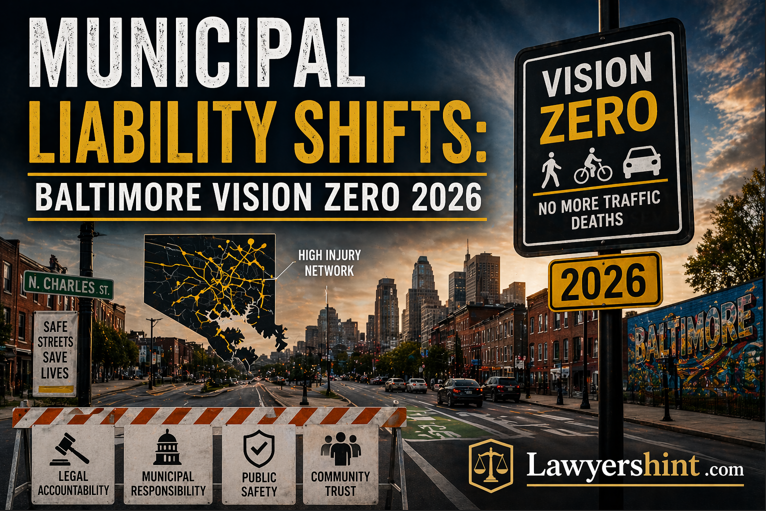
Baltimore City is undergoing a massive transformation in how it handles traffic safety and municipal accountability. At the center of this shift is the 2026 Vision Zero Action Plan. Backed by the Baltimore City Department of Transportation (BCDOT) and local universities, this initiative aims to eliminate traffic fatalities.
However, the publication of a highly specific data set known as the High Injury Network (HIN) is creating an unexpected legal ripple effect. For those involved in traffic accidents, understanding this data is highly important.
Understanding the High Injury Network Data
According to the official Vision Zero Action Plan published on the Streets of Baltimore portal, 60 percent of fatal and serious injury crashes occur on just 7 percent of the city roadways. To address this disparity, BCDOT collaborated with the Maryland Transportation Research and Artificial Intelligence Laboratory at the University of Maryland to build the official High Injury Network.
This network compiles structured crash data from 2019 through 2023. The methodology heavily weights specific types of accidents to prioritize municipal interventions. Fatal crashes carry the highest weight in their statistical calculations. Non-motorist crashes involving pedestrians, bicyclists, and wheelchair users are weighted second. The city explicitly noted that these individuals lack the physical protection of a vehicle and therefore carry a higher inherent risk of injury. All other serious injury crashes are weighted third.
The resulting map categorizes Baltimore roads into three distinct risk tiers. Tier 1 represents the highest level of risk for fatalities and debilitating injuries. Tiers 2 and 3 represent the next highest levels of statistical danger. By clearly defining these zones in a public database, the city has created a permanent record of known infrastructure hazards.
The Concept of Constructive Notice and Municipal Liability
In personal injury law, taking legal action against a municipality requires proving that the city knew or should have known about a dangerous condition and failed to fix it. This legal standard is known as constructive notice. Historically, cities defend themselves against infrastructure related lawsuits by claiming they were entirely unaware of a specific hazard at an isolated intersection.
The publication of the 2026 Vision Zero High Injury Network removes that defense for accidents occurring on flagged roads. If an intersection is marked as a Tier 1 hazard on the HIN, the city has officially acknowledged its dangerous design or lack of safety features in a published document. If a pedestrian is struck by a vehicle at that exact location due to poor lighting, missing crosswalks, or faulty traffic signals, the city can no longer claim ignorance.
This public acknowledgment shifts the burden of responsibility. When the city publicly maps its most dangerous corridors, it assumes a legal duty to prioritize repairs and implement safety measures in those specific areas. Extended delays in fixing known Tier 1 intersections can now be utilized as direct evidence of municipal negligence in court.
The Challenge of Contributory Negligence in Maryland
In Maryland, personal injury cases are governed by the strict legal doctrine of pure contributory negligence. Under this state law, if an injured party is found to be even one percent at fault for their own accident, they are completely barred from recovering any financial damages. This creates a high barrier for plaintiffs seeking compensation.
However, the Vision Zero HIN data provides a new counterargument for legal teams. Defense attorneys and insurance companies frequently attempt to blame pedestrians for crossing just outside a crosswalk or blame drivers for minor speeding to trigger the one percent fault threshold. By utilizing the city’s own HIN documentation, a plaintiff can demonstrate that the road design itself was fundamentally flawed and inherently dangerous.
If the public data proves that a specific intersection routinely confuses drivers or obscures pedestrians due to poor municipal engineering, lawyers can argue that the primary and sole cause of the accident was the city negligence, shifting the focus away from minor human errors.
Navigating the Local Government Tort Claims Act
When suing a municipality like Baltimore City, plaintiffs must also be aware of the Maryland Local Government Tort Claims Act (LGTCA). This statute places a strict cap on the amount of financial damages an injured person can recover from a local government entity. Even if a jury awards a massive sum for a catastrophic injury that occurred on a Tier 1 High Injury Network street, the LGTCA limits the actual monetary payout the city is required to provide.
Because of these statutory caps, attorneys must be highly strategic when reviewing HIN related cases. In situations involving severe injuries, lawyers will look for every available avenue of compensation. This often involves holding a private contractor responsible if they were hired to fix a road on the HIN but failed to complete the work to code. By thoroughly investigating the chain of command and maintenance contracts related to the Vision Zero Action Plan, legal teams can identify third party liability that is not restricted by government damage caps.
The Role of Baltimore Personal Injury Lawyers
Baltimore personal injury lawyers are currently integrating this public HIN data into their case strategies to establish concrete timelines of municipal inaction.
When an accident occurs, legal teams immediately check the GPS coordinates against the High Injury Network map. If the crash happened on a highlighted corridor, attorneys can file public information requests to discover when the city first identified the hazard and what steps were taken to mitigate the risk. If the BCDOT allocated funds for a Vision Zero quick-build project at that location but delayed the construction, that administrative delay becomes a focal point of the personal injury lawsuit.
Furthermore, lawyers use the HIN to strengthen claims for injured pedestrians and cyclists. Because the city specifically notes in its Vision Zero literature that non-motorists face a higher risk of death, attorneys can successfully argue that the city held a heightened responsibility to protect these vulnerable groups in flagged Tier 1 zones.
A Perspective from Steven H. Heisler
Taking on a city government requires aggressive legal representation and a deep understanding of local statutes. Baltimore personal injury lawyer, Steven H. Heisler, known locally as “The Injury Lawyer,” has built a career on holding powerful entities accountable. Before becoming a lawyer in 1988, he worked as a union organizer and fought as a Golden Gloves boxer. That background shaped his direct approach to legal disputes. He understands that injured individuals need an advocate who will not back down when facing well-funded municipal defense teams or massive insurance conglomerates.
Regarding the shifting dynamics of accident claims and municipal accountability, Steven H. Heisler offers a clear perspective on the matter:
“An injured person deserves compensation when the very infrastructure they rely on is neglected.”
His focus remains entirely on injury cases, ensuring that victims of negligent road design or poor municipal maintenance receive the aggressive representation their cases demand.
What This Means for Victims of Traffic Accidents
If you are injured in a traffic collision in Baltimore, the geographic location of the incident is now just as legally significant as the actions of the other driver. Victims must take specific steps to protect their legal rights following an incident.
First, document the scene extensively. Take photographs of the road conditions, traffic signals, and any missing or obscured signage. Second, report the exact location to your legal counsel so they can cross-reference the site with the Vision Zero High Injury Network. If the accident occurred in a high-risk tier, your claim might expand beyond a simple driver-against-driver dispute to include a complex municipal liability claim.
Third, act quickly. Claims against a government entity in Maryland involve strict administrative deadlines. The Local Government Tort Claims Act requires plaintiffs to provide formal written notice to the municipality within a specific timeframe. This deadline is often much shorter than the standard statute of limitations for private personal injury lawsuits. Failing to meet this administrative deadline can result in the complete dismissal of your claim, regardless of how negligent the city was in maintaining the road.
As the Vision Zero Action Plan moves forward, the city has committed funding to complete streets programs and safety interventions. However, until those physical changes are finalized, the High Injury Network serves as both a roadmap for city planners and a ledger of liability. Drivers, cyclists, and pedestrians must remain vigilant, knowing that the roads flagged by the city carry documented risks. By understanding the legal implications of the HIN, Baltimore residents can better protect their physical safety and their legal rights following an accident.