
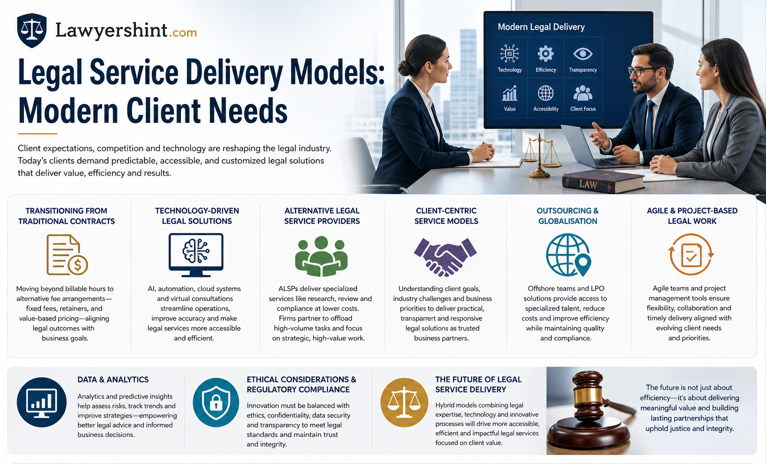

Legal service delivery models are evolving to meet client needs through technology, flexible pricing, and efficient, client-focused legal solutions.
- Transitioning from traditional contracts
- Technology-Driven Legal Solutions
- How Alternative Legal Service Providers Are Getting Ahead
- Client-Centric Service Models
- Outsourcing of Legal Services and the Globalisation
- Agile and Project-Based Legal Work
- The Big Deal About Data and Analytics
- Ethical Considerations and Regulatory Compliance
- Legal: Its Future of Service Delivery
Client expectations, competition and technology have all been rapidly changing the face of the legal industry over the past decade. The era of billable hours and in-person consultations defined traditional law firm structures but they are being redefined for greater efficiency, transparency, and value.
Clients ranging from individuals to Fortune 500 companies, today expect more than effective legal services; they want predictably priced, accessible and customized solutions. Consequently, this is drastically altering the way that legal assistance obtains crucial adaptive models and channels of interchange.
Transitioning from traditional contracts
Traditionally, legal service is totally based on the billable hour where you would build clients according to the hours spent by a lawyer in a particular case. Although this technique is prevalent, criticism has arisen for its lack of cost predictability and possible inefficiency. Clients increasingly demand alternative fee arrangements that are transparent and align legal outcomes with business goals.
Contemporary delivery methods commonly reflect fixed-fees, retainer depend on techniques, or different value-based pricing structures. The purpose of these approaches is to help clients better control their legal budgets while promoting efficiency and outcome not billable hours at law firms. For legal practitioners, this change entails a greater awareness of client objectives and a more calculated means of conducting cases.
Technology-Driven Legal Solutions
The role of technology is a linchpin for the delivery of modern legal services. For example, artificial intelligence (AI), document automation and cloud-based case management systems are some ways that allow law firms to streamline operations and reduce administrative hassles. These innovations do this while making legal work more efficient, accurate and high quality.
Some are research-oriented tools that can operate similarly to a search engine, and legal tech versions of natural language processing will scan documents and extract information much more efficiently than could be performed manually. Moreover, virtual consultation platforms have also enabled clients to obtain remote legal advice from anywhere in the world and virtually eliminated geography as a barrier while reducing face-to-face meetings.
Additionally, the integration of technology has resulted in legal tech start-ups and alternative legal service providers that provide cost-effective services with specialised knowledge and compete against traditional firms. It has made the client more confident and competitive within the legal marketplace.
How Alternative Legal Service Providers Are Getting Ahead
Alternative Legal Service Providers (ALSPs) have become more central on the legal scene. These organisations provide legal research, document review, compliance support and contract management services at a low cost compared with traditional legal firms. ALSPs can provide superior quality services more efficiently by narrowing their focus to specific areas of legal work.
More law firms are partnering with ALSPs to offload low-level or high-volume tasks from lawyers so that they can devote their time to more sophisticated and strategic work. The combination of human intelligence, extensive legal knowledge and technology elevates the entire service delivery while ensuring impactful high-quality services provided. This translates to quicker delivery times and cheaper solutions for clients.
Client-Centric Service Models
And this has an obvious resonance with modern legal service delivery, which is moving dramatically toward client-centricity. It is about the law firms who now understand that if they know their clients and their CTQs– what are the Challenges, Trends, Quirks of an industry or sector with which their clients operate; followed by the relevance of these quirks to business then lawyers can help them set long term strategy. This method is not simply providing legal counsel; it means being a trusted business partner and an essential part of the company strategy.
Methodologies that are client centric focus on communication, transparency and responsiveness. It creates trust and strengthens these relationships for the long-term.
Having vetted lawyers especially in specific fields like healthcare law or financial compliance is critical then. Professionals seeking guidance with complicated regulatory matters will find a judge trained to understand the rules of legal and operational procedures in Medicare that need to be adhered to (and even when they don’t).
Outsourcing of Legal Services and the Globalisation
Globalisation has shaped the way legal services are offered even further. Today, outsourcing in the form of offshore teams has become common for law firms to eliminate inefficiencies and access specialized talent at lower costs. The pragmatic way –for the firms- is to embrace technology as with increased workflow, LPO enables managing the same efficiently without compromising on quality.
This is especially useful for large projects, such as those involving discovery in litigation or compliance audits. Law firms can provide more competitive and quickly delivered service by tapping global resources. Even though outsourcing is mostly very fruitful, it requires managing certain risks to assure data safety, confidentiality as well as fulfilment of domestic legislation.
Agile and Project-Based Legal Work
Agile methodologies and project-based approaches have become another emerging trend in legal practice. Agile frameworks, which have their origins in the tech industry, focus on flexibility, collaboration and incremental progress. Legal operates increasingly as smaller, highly-targeted and agile teams who achieve incremental results that are rapidly aligned with shifts in client demand.
More clients are utilizing project management tools to monitor progress, expeditiously deploy resources and guarantee timely completion of legal tasks. This organized approach increases efficiency and accountability, allowing clients to track the progress of their cases and recognize the value they are receiving.
The Big Deal About Data and Analytics
Data–driven decision making has now been recognized as an essential component of the modern legal service delivery. Large law firms are suddenly turning to analytics to evaluate the outcome of cases, track trends and make their strategies more efficient. On the one hand this enriches the quality of legal advice and on the other hand gives clients perspective to make business decisions.
Predictive analytics (for instance, predicting whether a lawsuit will be successful or what the risks are surrounding a contract) This increase in data will enable legal professionals to obtain insight and future trends thus providing better guidance than before.
Ethical Considerations and Regulatory Compliance
Although there are changes in the service delivery model of legal services, ethical principles and rules still play important roles regarding compliance. Technology, outsourcing, and alternative providers are important but have to be balanced with maintaining client confidentiality and data security as well as professionalism.
It is imperative that the law firms assure that each bit of their operations are compliant with pertinent legal and ethical standards. This involves protecting confidential information, ensuring billing processes are transparent and providing an extremely high level of professionalism. Not doing so can lead to reputational and legal damage. In highly regulated areas such as healthcare law, working with a specialized Medicare Fraud Defense Lawyer can be essential for navigating complex compliance requirements and avoiding costly legal consequences.
Legal: Its Future of Service Delivery
The legal service delivery will be negotiated with innovation and adaptation, as always planned for. Law firms will need to be agile and look towards the future, keeping pace with advancing technology and changing client expectations. It is expected that hybrid models of the old experts with new tools and processes become more prevalent.
This collaborative transformation will occur between law firms, technology providers and alternative service providers. Change, if accepted and implemented thinking of the clients’ needs, can lead to models in which legal services are delivered more efficiently, more accessible, and thus potentially more effectively.
The future of legal service delivery at the end of the day, is not all about efficiency; but about how we define the value we provide as a lawyer. With embracing past practices and modern methodologies with an eye focused more on the client and less on just the regional area of law you can build a bridge between historical legal thinking to new paths in order for the industry to function efficiently over time without sacrificing the ideas of what defines justice or integrity.