
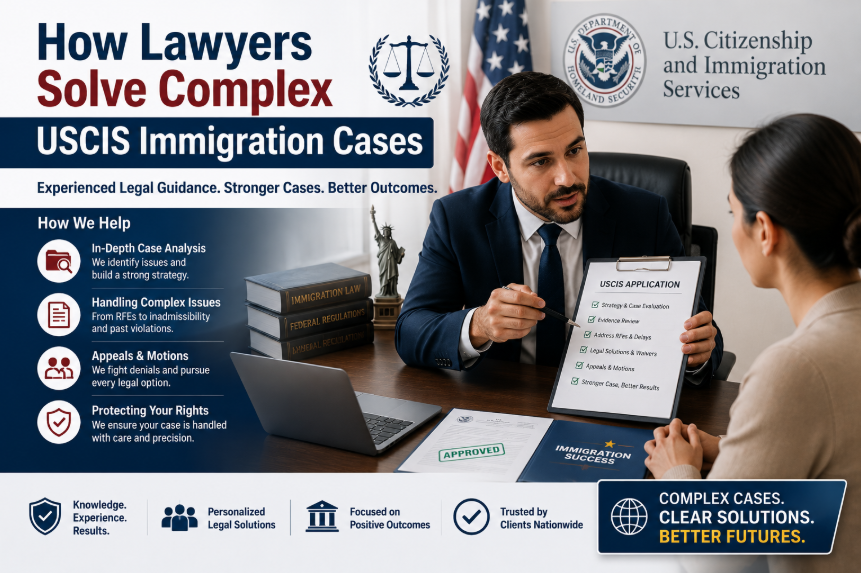

Facing complex USCIS immigration cases? Discover how an experienced immigration attorney can handle legal challenges and guide your application.
Mesa has become one of Arizona’s most dynamic communities, welcoming people from diverse backgrounds who come to build careers, reunite with family, and establish lasting roots in the United States. As the city’s population continues to grow, many residents find themselves navigating an immigration system that can quickly become overwhelming when unexpected issues arise.
A delayed application, conflicting records, or a request for additional evidence from U.S. Citizenship and Immigration Services can create uncertainty and place important life plans on hold. In these situations, understanding the process and responding strategically is just as important as completing the required paperwork.
Complex immigration matters often demand careful legal analysis, organized documentation, and clear communication with the government to avoid unnecessary setbacks. Working with an experienced Mesa immigration lawyer can provide the guidance needed to address complicated USCIS cases, helping applicants protect their opportunities while pursuing lawful status with greater confidence and a well-prepared legal strategy.
Early Case Review
Before any new filing goes out, counsel studies prior petitions, entry dates, notices, and court material, then compares each item for gaps or contradictions. That review often changes the direction of a case. For families seeking local guidance, an immigration lawyer can pinpoint weak spots in the record, explain timing issues, and identify realistic forms of relief based on the documented history.
Error Control
Immigration forms leave little room for approximation. Dates, names, addresses, and prior answers must match earlier submissions and supporting records. One inaccurate response can raise credibility concerns that follow a person for years. Attorneys cross-check forms against passports, tax filings, civil certificates, and receipt notices. That process helps catch discrepancies before the government does, reducing avoidable friction and keeping the case internally consistent.
Stronger Evidence
Hard cases rarely fail because a person lacks a story. Trouble usually starts when proof arrives scattered, thin, or poorly framed. Lawyers shape evidence into a record that answers likely questions before an officer asks them. Medical letters, school files, payroll records, affidavits, and travel history each serve a distinct function. Order matters. A clear packet helps the reviewer follow facts without guessing what piece supports which claim.
Waiver Strategy
Some applicants need a waiver after unlawful presence, a prior removal order, a misrepresentation finding, or certain criminal conduct. Those filings depend on legal framing, not form completion alone. Counsel must show how hardship affects relatives in practical terms, including treatment needs, income loss, caregiving duties, and emotional strain. A well-built submission addresses damaging facts directly and explains why relief still fits the law.
Requests for Evidence
A request for evidence can reopen the case record in a useful way. Officers issue them when proof seems incomplete, inconsistent, or insufficient for a legal element. Attorneys study the notice line by line, then prepare a response tied to each concern. Fresh records, a tighter timeline, and a plain explanation often make the difference. Precision matters more than volume at that stage.
Interview Preparation
An interview tests far more than memory. Officers watch for consistency, detail, and whether answers fit the written record. Preparation helps applicants understand where pressure points may arise before they enter the room. Lawyers review prior filings, travel dates, relationship history, and sensitive facts that may draw extra attention. Practice sessions can expose confusion early, which gives people time to correct records or gather clarifying documents.
Delays and Denials
Long delays may indicate background checks, file transfer issues, supervisory review, or records requiring manual reconciliation. Counsel can trace what is normal and what signals trouble. If a denial arrives, the written decision must be read carefully for legal and factual errors. Timing becomes critical at that point. An attorney can assess whether refiling, appealing, or reopening offers the strongest path.
Family and Humanitarian Relief
Some matters involve abused spouses, abandoned children, or relatives facing removal while another benefit remains pending. These files require careful sequencing because a single statement can affect multiple applications at once. Lawyers help clients present facts consistently across every submission. Good planning can preserve eligibility, limit harmful admissions, and protect relief that might disappear if forms are filed in the wrong order or without context.
Court and Agency Overlap
A case becomes harder when immigration court and agency filings move at the same time. Dates must align, legal positions must remain coherent, and evidence cannot point in opposite directions. Attorneys coordinate those tracks so one forum does not undercut the other. They also explain how a pending petition, waiver, or status request may influence hearing strategy, bond arguments, or requests for case closure.
Legal Help’s Practical Value
Legal help is not limited to paperwork. It brings order to chaotic facts and turns a loose collection of records into a persuasive file. Applicants benefit from tighter timelines, sharper evidence selection, and responses that align with what officers need to decide. That support can shorten the delay. In higher-risk matters, it may also preserve future options that a rushed filing could damage for years.
Conclusion
The success of a difficult immigration hinges on consistency, timing, and proof that meets the legal standard. One form alone rarely decides the outcome. An immigration attorney helps connect history, documents, and law into a record the agency can review with less confusion. For people facing waivers, denials, interviews, or overlapping court issues, that level of care can make the process steadier, clearer, and more defensible.