
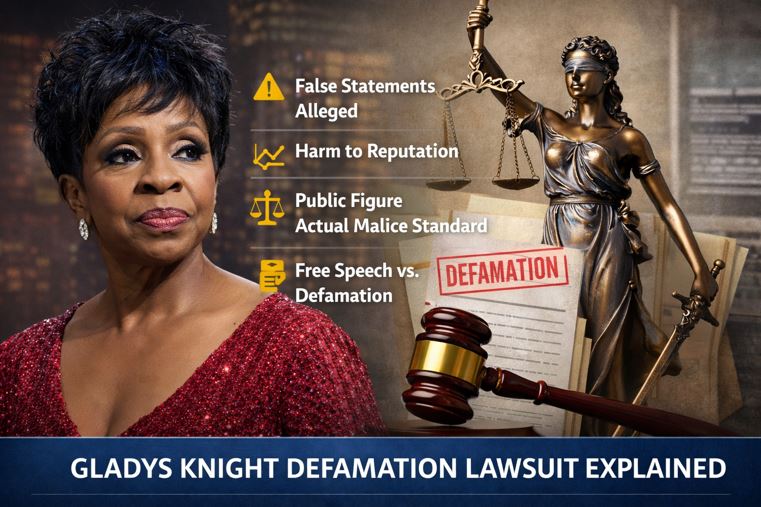

An in-depth look at the Gladys Knight defamation lawsuit, including allegations, legal standards, case impact, and key lessons from defamation law.
- Understanding Defamation Lawsuits
- Key Facts at a Glance
- Who Is Gladys Knight?
- Background of the Gladys Knight Defamation Lawsuit
- Core Allegations in the Lawsuit
- Legal Standard for Public Figures
- Evidence Typically Used in Defamation Cases
- Possible Defenses Raised by Defendants
- Potential Outcomes of the Lawsuit
- Impact on Gladys Knight’s Career and Reputation
- Broader Implications for Celebrities
- Lessons for Media and the Public
- Defamation and the First Amendment
- Current Status and Legal Timeline
- Defamation Lawsuit Essentials
- Frequently Asked Questions (FAQ)
- Final Thoughts
The Gladys Knight defamation lawsuit has attracted widespread attention due to the legendary singer’s global reputation and the sensitive nature of defamation claims involving public figures. When a name as iconic as Gladys Knight becomes linked to a lawsuit, public curiosity naturally follows.
However, beyond headlines and speculation, it is essential to understand what a defamation lawsuit actually involves, why such claims arise, and how courts analyze them, especially when celebrities are involved.
This article provides a comprehensive, plain-language explanation of the Gladys Knight defamation lawsuit, the legal principles behind defamation claims, potential outcomes, and broader implications for public figures.
Understanding Defamation Lawsuits
Before diving into the specifics of the Gladys Knight defamation lawsuit, it helps to understand the legal foundation of defamation.
Defamation generally refers to false statements presented as facts that harm a person’s reputation. In U.S. law, defamation is divided into two categories:
- Libel – Written or published defamatory statements
- Slander – Spoken defamatory statements
For a claim to succeed, the plaintiff must typically prove that the statement was false, damaging, and made without adequate legal justification.
Key Facts at a Glance
| Aspect | Details |
| Lawsuit Type | Defamation (Libel or Slander) |
| Public Figure Status | Gladys Knight (celebrity/public figure) |
| Legal Standard | Actual malice |
| Core Issue | Allegedly false statements harming reputation |
| Potential Outcome | Dismissal, settlement, or court judgment |
Who Is Gladys Knight?
Gladys Knight is an internationally respected singer, songwriter, and performer, often referred to as the “Empress of Soul.” With a career spanning decades, she has built a reputation not only as a musical icon but also as a businesswoman and philanthropist.
Because of her fame, Gladys Knight is legally considered a public figure, which significantly affects how defamation law applies. Public figures face higher legal hurdles when pursuing defamation claims, making any lawsuit involving them particularly complex.
Background of the Gladys Knight Defamation Lawsuit
The Gladys Knight defamation lawsuit centers on claims that false statements were made publicly, allegedly harming her personal and professional reputation. While details may vary depending on filings and jurisdiction, such lawsuits commonly arise from:
- Media publications
- Online statements or social media posts
- Interviews or public commentary
- Business or contractual disputes
In defamation cases involving celebrities, even a single widely circulated statement can cause substantial reputational and financial harm.
Core Allegations in the Lawsuit
Although defamation cases differ in specifics, the Gladys Knight defamation lawsuit typically involves allegations such as:
False Statements Presented as Facts
The plaintiff may argue that statements were not opinions but assertions presented as factual, despite being untrue.
Damage to Reputation
Reputational harm can include loss of professional opportunities, public trust, or emotional distress.
Widespread Publication
Defamation requires that the statements be communicated to a third party, often through media or digital platforms.
Lack of Verification
Claims may include allegations that the defendant failed to verify information before making it public.
Legal Standard for Public Figures
One of the most important aspects of the Gladys Knight defamation lawsuit is the “actual malice” standard.
What Is Actual Malice?
Actual malice does not mean ill will. Instead, it means that the defendant:
- Knew the statement was false, or
- Acted with reckless disregard for whether it was true or false
This high standard was established by the U.S. Supreme Court to protect freedom of speech and the press.
Because Gladys Knight is a public figure, proving actual malice is essential for her claim to succeed.
Evidence Typically Used in Defamation Cases
In lawsuits like the Gladys Knight defamation lawsuit, courts often examine:
- Emails, texts, or internal communications
- Editorial processes and fact-checking efforts
- Witness testimony
- Financial or reputational impact documentation
- Public statements and media reach
The burden of proof lies heavily on the plaintiff, especially when public figure status applies.
Possible Defenses Raised by Defendants
Defendants in defamation cases often rely on several common defenses:
Truth
Truth is an absolute defense. If the statement is proven true, defamation claims fail.
Opinion
Statements clearly framed as opinions rather than facts may be protected.
Privilege
Certain statements made in legal or governmental proceedings may be immune.
Lack of Malice
For public figures, showing a lack of actual malice can defeat the claim.
These defenses play a central role in determining the outcome of the Gladys Knight defamation lawsuit.
Potential Outcomes of the Lawsuit
Defamation lawsuits rarely follow a single predictable path. Possible outcomes include:
Case Dismissal
If the court finds insufficient evidence, the lawsuit may be dismissed early.
Settlement
Parties may agree to a private settlement, sometimes including retractions or clarifications.
Court Judgment
If the case proceeds to trial, a judge or jury may rule in favor of either party.
Injunctive Relief
In rare cases, courts may order the removal of defamatory content.
Impact on Gladys Knight’s Career and Reputation
Even when claims are unproven, litigation can attract public attention. However, celebrities like Gladys Knight often pursue defamation lawsuits to protect long-standing reputations built over decades.
While lawsuits can temporarily generate headlines, they can also serve as formal mechanisms to correct false narratives and deter future misconduct.
Broader Implications for Celebrities
The Gladys Knight defamation lawsuit highlights broader issues faced by public figures, including:
- Rapid spread of misinformation
- Increased scrutiny in the digital age
- Challenges of protecting reputation online
- Balancing free speech with accountability
As social media amplifies voices worldwide, defamation law continues to evolve in response.
Lessons for Media and the Public
This case underscores the importance of responsible communication. Key takeaways include:
- Verify information before publishing
- Clearly distinguish fact from opinion
- Understand legal risks of public statements
- Respect reputational rights
Defamation law does not silence criticism, it ensures accountability for false factual claims.
Defamation and the First Amendment
A major reason defamation lawsuits are difficult for public figures is the First Amendment. Courts strive to balance:
- Freedom of speech and press
- Protection against reputational harm
The Gladys Knight defamation lawsuit illustrates how courts attempt to maintain this balance in high-profile cases.
Current Status and Legal Timeline
Defamation lawsuits often take months or years to resolve. Motions to dismiss, discovery phases, and potential appeals can significantly extend timelines.
Observers typically monitor court filings, rulings, and settlement announcements to understand how the case progresses.
Defamation Lawsuit Essentials
| Element | Explanation |
| False Statement | Must be provably false |
| Publication | Shared with a third party |
| Fault | Negligence or actual malice |
| Harm | Reputational or financial damage |
| Defense | Truth, opinion, privilege |
Frequently Asked Questions (FAQ)
What is the Gladys Knight defamation lawsuit about?
It involves allegations that false statements were made publicly, allegedly harming Gladys Knight’s reputation.
Is Gladys Knight a public figure under the law?
Yes. As a well-known entertainer, she is considered a public figure, requiring proof of actual malice.
Does criticism count as defamation?
Not usually. Opinions and fair criticism are protected unless false facts are presented as truth.
Can defamation lawsuits be settled?
Yes. Many defamation cases end in private settlements before trial.
Why are defamation cases hard to win?
Strong free speech protections and high legal standards make defamation claims challenging, especially for public figures.
Final Thoughts
The Gladys Knight defamation lawsuit serves as a powerful reminder of how reputations, free speech, and legal accountability intersect. While courts ultimately decide the merits of each claim, the case highlights the growing importance of accuracy and responsibility in public discourse.
As misinformation spreads faster than ever, defamation law remains a critical safeguard, protecting individuals while preserving the fundamental right to speak freely.