
Blind spot truck crashes, often called “No-Zone” accidents, can happen in seconds when a tractor-trailer changes lanes, makes a wide turn, merges, or backs up. Yet determining fault is rarely as simple as saying that the smaller vehicle was invisible. In crashes involving life-changing harm, the issues raised by amputation and severe limb injury claims from motorcycle wrecks can also underscore why a careful review of evidence is so important.
- What Is a Truck No-Zone?
- How Fault Is Determined After a No-Zone Truck Accident
- Common Truck Blind-Spot Accident Scenarios
- Evidence That Can Help Establish Fault
- When the Trucking Company May Share Responsibility
- What to Do After a Blind-Spot Truck Crash
- Can Both Drivers Be at Fault?
- Questions Often Asked
- Conclusion
Large trucks have substantial blind spots along both sides, directly behind the trailer, and immediately in front of the cab. Still, truck drivers have a duty to operate carefully, use mirrors, signal, adjust to road conditions, and ensure a lane change or turn can be completed safely. Passenger-vehicle drivers also have responsibilities, including avoiding prolonged travel in areas where they cannot be seen.
What Is a Truck No-Zone?
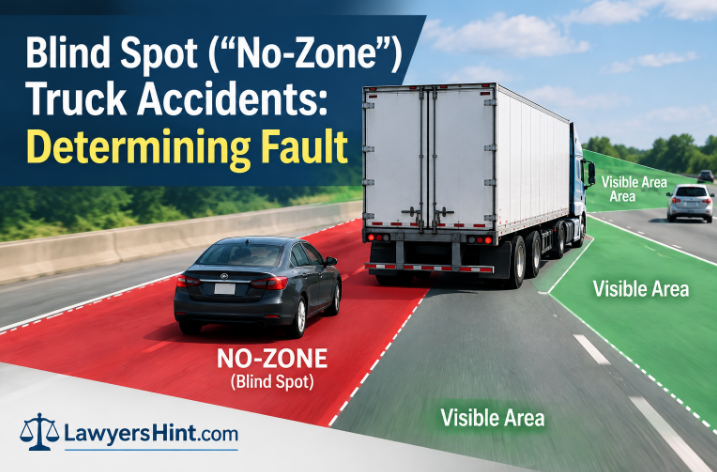
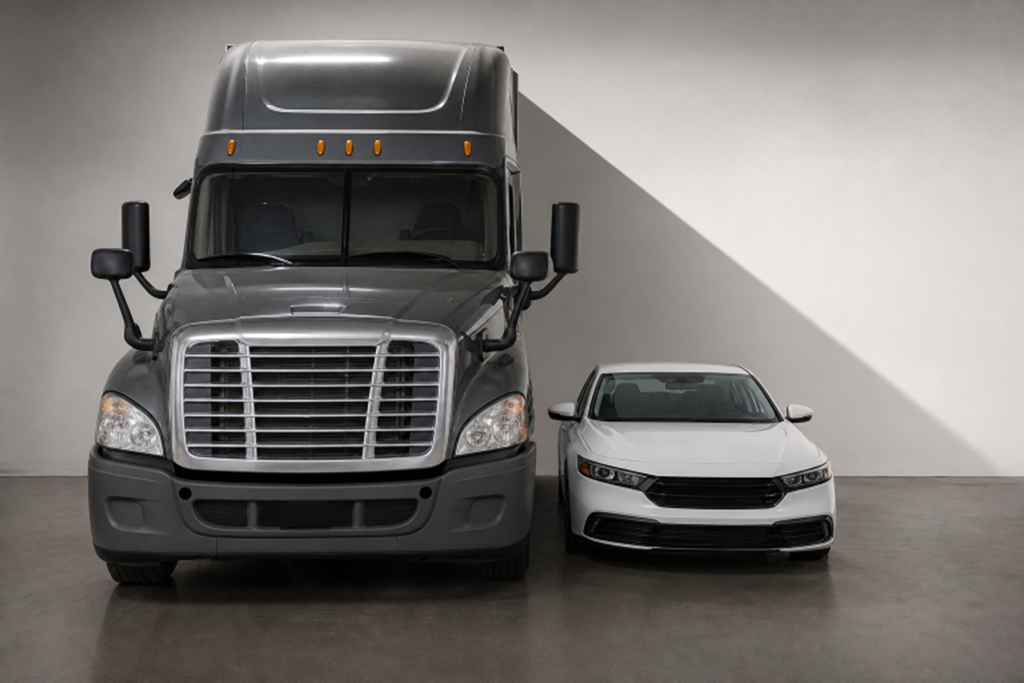
A No-Zone is an area around a commercial truck where the driver may have limited or no visibility. The zones are especially significant on the truck’s right side, behind the trailer, and near the front of the cab. Federal safety guidance advises motorists to avoid lingering in truck blind spots, because the driver may not be able to see them either. Avoiding truck blind spots is an important safety practice, but it does not eliminate a commercial driver’s obligation to check traffic before moving.
The phrase “blind spot” can be misleading in a fault dispute. A driver cannot simply claim that another vehicle was in a No-Zone and end the inquiry. Investigators must examine whether the truck driver signaled, checked mirrors, had enough time to observe surrounding traffic, made an abrupt maneuver, or ignored a vehicle that was visible before entering the blind spot.
How Fault Is Determined After a No-Zone Truck Accident
Insurance companies, police investigators, and attorneys usually reconstruct the collision by looking at each driver’s actions immediately before impact. The central question is whether one or more parties acted unreasonably under the circumstances.
Which Vehicle Changed Position?
A truck driver who moves into an occupied lane may be responsible for failing to make a safe lane change. Conversely, a car driver who rapidly cuts in front of a truck, merges without sufficient space, or passes on the right while a truck begins a turn may bear some or all of the responsibility.
Did the Truck Driver Signal and Check Surroundings?
Turn signals, brake lights, mirror checks, camera systems, and driver attention are often central issues. A driver who signals late, fails to signal, or starts moving without checking mirrors may have created a preventable risk. Dashcam footage and nearby traffic-camera video can be particularly useful when accounts conflict.
Did Road Conditions Affect Visibility?
Rain, darkness, glare, construction barriers, heavy traffic, and poorly marked lanes can make a No-Zone crash more complicated. These conditions do not excuse careless driving. Instead, they may require both drivers to slow down, leave more space, and take additional time before changing lanes or turning.
Common Truck Blind-Spot Accident Scenarios
- Lane-change sideswipes: A truck moves into an adjacent lane occupied by a car, motorcycle, or SUV.
- Right-turn collisions: A truck swings left to make a wide right turn and strikes a vehicle, cyclist, or pedestrian on the right.
- Merge crashes: A truck enters a highway or shifts lanes for construction, while another vehicle is already beside the trailer.
- Rear-end collisions: A vehicle follows too closely behind a trailer and cannot react when traffic slows.
- Backing accidents: A truck reverses in a loading area, parking lot, or roadway without properly checking the path behind it.
Evidence That Can Help Establish Fault
Truck accidents often produce more evidence than ordinary passenger-car collisions. Important information can disappear quickly, so documenting the event as soon as safely possible is valuable.
- Photos of vehicle positions, damage, debris, skid marks, signs, lane markings, and weather conditions.
- Pictures of the truck’s cab number, trailer number, license plate, company name, and USDOT number.
- Witness names, contact information, and brief notes about what each person saw.
- Police report details, including the officer’s observations and any traffic citations.
- Dashcam footage, surveillance video, and recordings from nearby businesses or homes.
- Electronic logging data, vehicle event data, GPS records, inspection reports, and maintenance records.
- Driver qualification, training, and disciplinary records when the trucking company’s practices are in question.
When the Trucking Company May Share Responsibility
The driver is not always the only potentially responsible party. A motor carrier may be accountable if it hired an unqualified driver, failed to provide adequate blind-spot training, encouraged unrealistic delivery schedules, ignored prior safety concerns, or allowed unsafe equipment to remain in service.
Fatigue can also matter. Federal hours-of-service rules limit commercial driving and require rest periods intended to help drivers remain alert. If records suggest a driver exceeded allowable hours, falsified logs, or was pressured to keep driving while fatigued, that information may affect the fault analysis.
What to Do After a Blind-Spot Truck Crash
- Move to a safe location if possible, call 911, and request medical assistance.
- Give police a factual account without guessing about speed, distance, or fault.
- Take photos and video only when it is safe to do so.
- Exchange information and collect the trucking company’s identifying details.
- Seek a medical evaluation, even if symptoms seem manageable at first.
- Save medical records, repair estimates, receipts, missed-work information, and insurance communications.
- Avoid posting details, images, or opinions about the crash on social media.
Can Both Drivers Be at Fault?
Yes. Many states allow fault to be divided among multiple parties. For example, a truck driver may have changed lanes without adequately checking mirrors, while the car driver may have been speeding or remained alongside the trailer for an extended period. The percentage assigned to each party can affect insurance payments and any later claim, depending on state law.
Questions Often Asked
Does a car driver automatically lose because they were in a blind spot?
No. A blind spot is relevant evidence, not an automatic defense. The full sequence of events, including the truck driver’s maneuver and opportunity to see surrounding traffic, must be reviewed.
What if the truck driver says they never saw my vehicle?
That statement may support further investigation rather than end it. The question is whether the driver should have seen the vehicle by checking mirrors, signaling earlier, using available safety equipment, or waiting before moving.
Why should evidence be preserved quickly?
Camera footage can be overwritten, witnesses can become difficult to locate, and electronic records may not be retained indefinitely. Early documentation can make it easier to evaluate competing versions of the crash.
Conclusion
A truck No-Zone accident requires more than a quick assumption about who could see whom. Fault may depend on lane position, signals, speed, visibility, driver attention, company practices, and physical evidence from the scene. Prompt medical care, accurate documentation, and preservation of trucking records can help provide a clearer account of how the collision occurred.