
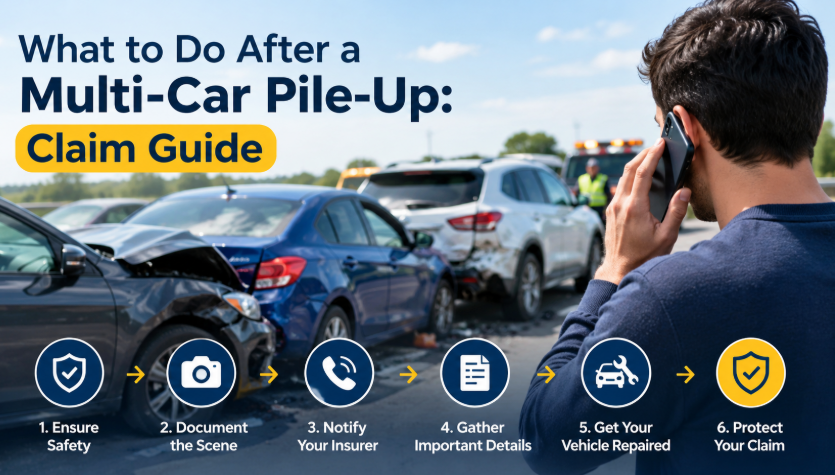

A multi-car pile-up can leave drivers unsure about what happened, who caused the crash, and which insurance company should cover the damage. Unlike a collision involving two vehicles, a chain-reaction accident can involve several impacts, conflicting driver accounts, and questions about how each vehicle contributed to the injuries.
- 1. Get to Safety and Report the Accident
- 2. Document the Scene Before Evidence Disappears
- 3. Get Medical Attention and Keep Your Records
- 4. Understand Why Fault Is Complicated in a Chain-Reaction Crash
- 5. Notify Your Insurance Company Without Guessing About Fault
- 6. Preserve Evidence That Could Establish the Collision Sequence
- 7. Track Every Financial Loss Connected to the Accident
- 8. Review Settlement Offers and Know Your Legal Deadlines
- Protecting Your Claim Starts With the Right Information
Knowing what to do after a multi-car accident helps protect your safety and your ability to pursue compensation. The steps you take at the scene and in the following days can affect how insurers investigate the collision and determine responsibility.
1. Get to Safety and Report the Accident
Your first priority is preventing additional injuries. Multi-car crashes are especially dangerous on highways, where approaching drivers might not see stopped traffic in time.
If you can move your vehicle safely, follow local traffic laws and move away from active traffic lanes. If the vehicle cannot be moved, remain alert to approaching traffic and follow emergency responders’ instructions.
Once you are safe:
- Call 911 and report the location, number of vehicles involved, and any visible injuries.
- Request medical assistance for anyone who appears injured.
- Avoid standing between damaged vehicles or near moving traffic.
- Follow instructions from police officers and emergency personnel.
- Do not attempt to move someone with a suspected serious injury unless immediate danger makes it necessary.
Reporting the crash creates an official record of the incident. Police officers can document vehicle positions, collect driver information, and identify witnesses.
2. Document the Scene Before Evidence Disappears
Multi-car accident scenes change quickly. Vehicles are moved, debris is cleared, and witnesses leave. Once traffic resumes, reconstructing the original sequence of events becomes more difficult.
If it is safe, gather evidence before leaving the scene. Drivers dealing with disputed liability in South Carolina can also consult a Greenville car accident lawyer to understand which records could support their claim.
Focus on collecting information that shows both the damage and how the collision unfolded.
Photograph the following:
- Damage to every accessible vehicle involved, including front, rear, and side impacts.
- Vehicle positions before tow trucks or emergency crews move them, when safe.
- Skid marks, broken glass, debris, and other physical evidence.
- Traffic signs, intersections, lane markings, and roadway conditions.
- Visible injuries and damaged personal belongings.
Exchange contact, insurance, and vehicle information with the other drivers. Record their license plate numbers and the names of their insurance companies.
If witnesses stopped to help, ask for their contact information. Someone who saw the first impact can provide information that drivers involved in later collisions never witnessed.
Avoid speculating about who caused the crash. Describe what you observed rather than trying to explain events you could not see.
3. Get Medical Attention and Keep Your Records
A crash involving several vehicles can expose occupants to multiple impacts. Someone might experience an initial rear-end collision followed by another impact that pushes their vehicle forward.
Even when injuries seem minor, getting a medical evaluation is important. Neck pain, headaches, dizziness, and other symptoms can become noticeable after the initial shock of the accident fades.
Explain what happened to your healthcare provider, including the direction of each impact you remember and any symptoms you have experienced.
Keep copies of:
- Emergency room and urgent care records.
- Diagnostic test results and treatment recommendations.
- Prescription receipts and medical bills.
- Physical therapy appointments and follow-up instructions.
- Work restrictions issued by medical professionals.
Follow the recommended treatment plan and communicate any new or worsening symptoms to your provider.
Medical documentation does more than establish treatment costs. It helps connect reported symptoms and injuries to the accident and provides a timeline of your recovery.
4. Understand Why Fault Is Complicated in a Chain-Reaction Crash
Determining fault in a multi-car accident requires examining how the collisions occurred.
Consider a situation where three vehicles are stopped in traffic. A fourth driver fails to brake and strikes the last vehicle, pushing it into the vehicles ahead.
The driver who initiated the collision could be responsible for the resulting damage. However, the analysis changes if another driver was following too closely, speeding, or failed to react to an earlier hazard.
Investigators look at factors such as vehicle damage, roadway conditions, witness statements, and available video footage to establish the sequence of impacts.
Can More Than One Driver Be Responsible?
Yes. Multiple drivers can contribute to the same accident through separate negligent actions.
For example, one driver might cause the initial collision while another contributes to additional damage by driving too fast for traffic conditions.
South Carolina follows a modified comparative negligence system. An injured person can generally recover compensation if their percentage of fault does not exceed 50%. Their own negligence reduces their recoverable damages, and responsibility can be divided among multiple parties who contributed to the accident.
This makes accurate documentation particularly important. An incorrect account of the collision sequence could influence how responsibility is assigned.
5. Notify Your Insurance Company Without Guessing About Fault
Report the accident to your insurance company promptly and follow the notice requirements in your policy.
Provide the basic facts, including the date, location, vehicles involved, and police report information. If you are uncertain about the order of impacts, explain that clearly.
Avoid making assumptions such as saying you caused the collision simply because your vehicle struck the car ahead. In a chain-reaction accident, that impact could have resulted from another vehicle pushing yours forward.
Insurance adjusters investigate claims by reviewing photographs, statements, damage estimates, and other available evidence.
You should also be cautious when speaking with another driver’s insurer. You can provide necessary identifying information without agreeing to a recorded statement or speculating about responsibility before you understand the full circumstances.
Do not sign a settlement agreement or release without understanding what rights you are giving up.
6. Preserve Evidence That Could Establish the Collision Sequence
The physical condition of the vehicles can help explain how a pile-up happened. Damage patterns, impact locations, and mechanical findings can provide clues about which collisions occurred first.
Additional evidence could include:
- Dashcam recordings from involved vehicles.
- Traffic camera footage from nearby intersections.
- Surveillance video from surrounding businesses.
- Photographs taken by witnesses.
- Tow truck records and vehicle inspection reports.
- Electronic vehicle data, when available and relevant.
Some recordings are automatically overwritten after a short period. Requesting relevant footage promptly improves the chances that it remains available.
If your vehicle is being stored, repaired, or declared a total loss, preserve existing photographs and repair records. When vehicle condition is disputed, discuss whether an inspection is needed before significant repairs or disposal.
For complicated collisions, accident reconstruction specialists can analyze vehicle damage, physical evidence, and other records to help explain the sequence of events.
7. Track Every Financial Loss Connected to the Accident
A multi-car accident claim involves more than vehicle repairs. Injuries can interrupt work, require ongoing treatment, and create expenses that are not immediately apparent.
Create a folder containing bills, receipts, insurance correspondence, and records of missed work.
Document expenses such as medical treatment, transportation to appointments, rental vehicles, and other accident-related costs.
If your injuries prevent you from working, request records showing missed hours, lost wages, or other affected income. For self-employed individuals, business records can help explain changes in earnings.
Keep a brief journal describing how your injuries affect daily activities. Record specific limitations, such as difficulty driving, lifting objects, sleeping, or completing household responsibilities.
These details provide context for losses that are not fully reflected in medical bills.
8. Review Settlement Offers and Know Your Legal Deadlines
When several vehicles and insurance policies are involved, settlement discussions can become complicated.
An insurer might dispute which collision caused a particular injury. Another might argue that a different driver bears most of the responsibility. Available insurance coverage can also affect how claims are resolved.
Before accepting a settlement, make sure you understand the extent of your injuries, the cost of treatment, and the losses the agreement is intended to resolve.
A signed settlement release can prevent you from pursuing additional compensation for claims covered by that agreement, even if unexpected expenses arise later.
In South Carolina, the general statute of limitations for personal injury lawsuits is three years, although exceptions and different deadlines can apply. Claims involving government entities can have additional requirements and shorter filing periods.
Starting the investigation early gives you more time to preserve evidence, identify responsible parties, and evaluate your legal options.
Protecting Your Claim Starts With the Right Information
A multi-car pile-up can create confusion about the order of impacts, which driver was responsible, and whose insurance should pay for the damage. Those questions are easier to address when the accident is documented from the beginning.
Prioritize safety, seek appropriate medical care, preserve evidence, and keep a clear record of your expenses and communications with insurers.
Understanding what to do after a multi-car accident does not guarantee a particular settlement. It puts you in a stronger position to explain what happened, challenge inaccurate claims about fault, and make informed decisions about your recovery.