
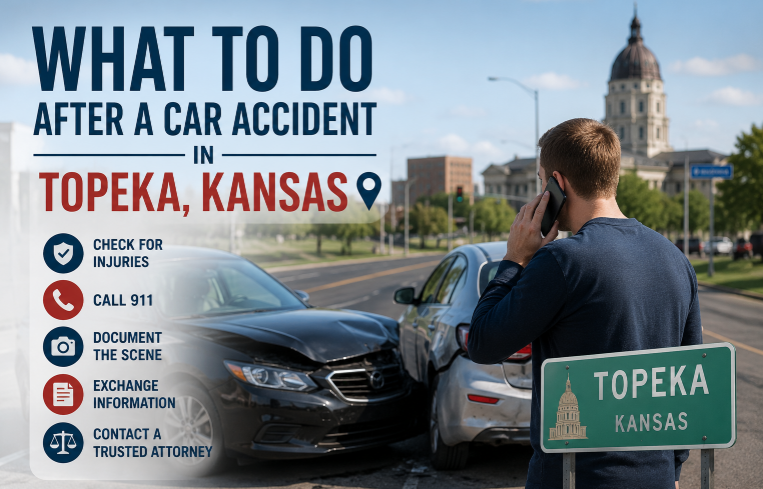

Learn what to do after a car accident in Topeka, Kansas. Follow the steps to protect your health, preserve evidence, and strengthen your injury claim.
- What are the first steps at the scene?
- Should you get medical care right away?
- How does Kansas no-fault insurance work?
- How does fault affect your recovery?
- What is the filing deadline in Kansas?
- What mistakes reduce the value of a claim?
- What are the most common causes of Topeka car accidents?
- What injuries commonly result from car accidents?
- How can a Topeka car accident attorney help?
After a car accident in Topeka, Kansas, secure the scene, get medical care, document everything, and understand how Kansas no-fault and comparative-fault rules affect your claim. What you do in the hours and days that follow shapes both your recovery and your ability to be compensated. Kansas law adds specific requirements that Topeka drivers should know.
This article covers the immediate steps and the legal framework that governs a Topeka car accident claim.
What are the first steps at the scene?
The first steps are to check for injuries, move to safety, and call 911 to report the crash. Kansas requires reporting accidents that involve injury, death, or property damage above a set threshold, and a police report creates an official record of the facts.
Collect evidence while you are there. Photograph the vehicles, the road, traffic signals, and any injuries. Exchange insurance and contact information with the other driver and gather witness details. Scene evidence is the most reliable and the hardest to reconstruct afterward.
Should you get medical care right away?
You should get medical care right away, even without obvious injuries, because conditions like concussions and whiplash can surface hours or days later. Immediate evaluation protects your health and links any diagnosis directly to the crash.
Insurers scrutinize the time between an accident and treatment. A prompt medical visit and consistent follow-up care make it far harder to argue your injuries were minor or unrelated.
How does Kansas no-fault insurance work?
Kansas is a no-fault state, so your own Personal Injury Protection coverage pays your initial medical expenses and lost wages regardless of fault. PIP is mandatory on every Kansas auto policy and provides fast access to benefits after a crash.
You can pursue a claim against the at-fault driver once your injuries cross a statutory threshold, such as permanent injury or medical bills above the state minimum. At that point you can seek full damages, including pain and suffering, and the Topeka car accident attorneys at Bretz Injury Law can assess whether your injuries meet that threshold.
How does fault affect your recovery?
Fault affects your recovery through Kansas modified comparative fault, which reduces damages by your share of blame and bars recovery at 50 percent or more. A driver 25 percent at fault recovers 75 percent of their damages, while one who is 50 percent or more at fault recovers nothing.
Because fault carries such weight, insurers work to pin responsibility on you. Photographs, witness statements, the police report, and sometimes reconstruction experts are used to establish the other driver’s fault accurately.
What is the filing deadline in Kansas?
The filing deadline for a Kansas car accident lawsuit is generally two years from the date of the crash. After that, the statute of limitations usually bars the claim permanently.
Deadlines can be shorter when a government vehicle or entity is involved, since claims against public bodies often carry separate notice requirements. Confirming your specific deadline early avoids losing the claim on a technicality. Official court information is available through the Kansas Judicial Branch.
What mistakes reduce the value of a claim?
The mistakes that most often reduce a claim’s value are admitting fault, giving recorded statements, settling too early, and posting on social media. Early settlement offers frequently precede a full diagnosis, and accepting one closes the claim even if your injuries worsen.
Recorded statements to the other driver’s insurer can be used to minimize your injuries or shift blame. And insurers monitor social media for anything that appears to contradict your claim. Caution in each of these areas protects your recovery.
What are the most common causes of Topeka car accidents?
The most common causes of car accidents in Topeka are distracted driving, speeding, impaired driving, and failure to yield. Distracted driving, particularly texting, has become a leading factor as phones compete for drivers’ attention.
Weather also plays a role in Kansas, where winter ice and sudden storms reduce traction and visibility. Intersections are frequent crash sites, often due to running red lights or misjudging turns. Identifying the cause of a crash matters because it points to who was at fault and what evidence will prove it. A rear-end collision, for example, usually suggests the following driver was inattentive, while an intersection crash may require witness accounts or camera footage to establish who had the right of way.
What injuries commonly result from car accidents?
Car accidents commonly cause whiplash, fractures, back and spinal injuries, concussions and other traumatic brain injuries, and soft-tissue damage. The severity ranges from minor and temporary to catastrophic and permanent.
Some of these injuries, especially concussions and whiplash, do not produce symptoms immediately, which is why prompt medical evaluation is important even when you feel unharmed. More serious injuries, such as spinal damage or a traumatic brain injury, can require surgery, long rehabilitation, and lasting accommodations. The nature and severity of the injury drive the value of a claim, because they determine current medical costs, future care needs, and the degree to which a person’s ability to work and enjoy life is affected. Thorough medical documentation captures all of this for the claim.
How can a Topeka car accident attorney help?
A Topeka car accident attorney helps by investigating the crash, proving fault, valuing damages, negotiating with insurers, and filing suit within the deadline. Attorneys know how to counter comparative-fault arguments and document the full cost of an injury, including future care and lost earning capacity.
Bretz Injury Law has decades of experience representing injured Kansans and handles personal injury and auto accident cases across the state. National data from the National Highway Traffic Safety Administration shows how often ordinary collisions cause lasting harm.
If you were injured in a Topeka crash, speak with an attorney before accepting any insurance offer so you understand the real value of your claim.
Recovering from a crash is stressful enough without also fighting an insurer over fault and value. An attorney lets you focus on healing while the legal and financial pieces are handled on your behalf. Before your first meeting, gather the police report, any photos you took, the other driver’s insurance details, and records of your medical care so the attorney can assess your claim accurately. The sooner that review happens, the more options remain to preserve evidence, meet deadlines, and build the strongest possible case. There is rarely a downside to understanding your rights early, and doing so often prevents costly missteps in the days right after a Topeka collision.