
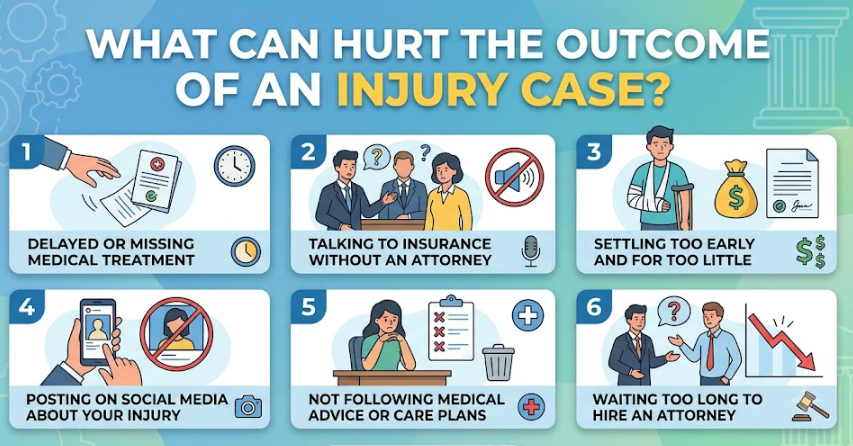

Discover the hidden obstacles that can affect your injury case, from delayed treatment to weak evidence, and learn how to protect your claim.
- Failure to Collect Adequate Evidence Immediately
- Overcoming Difficulties Posed By Insurance Companies
- Showing Proof of the Entire Injury Sustained
- Questions About Liability and Responsibility
- Making Mistakes During the Claims Process
- The Effect of Statutes of Limitations on Claims for Injury
- Why It Is Important to Have a Proper Legal Strategy
- Conclusion
When someone suffers an injury because of an accident, the physical pain is often only one part of the challenge. Many injury victims also face financial pressure, emotional stress, and uncertainty about what steps to take next. While some cases may appear straightforward, numerous hidden obstacles can affect the outcome of an injury claim.
Understanding these challenges can help injured individuals make informed decisions and avoid common mistakes that may weaken their ability to seek fair compensation. From evidence issues to insurance tactics, several factors can influence whether an injury case succeeds or falls short.
Failure to Collect Adequate Evidence Immediately
In an injury case, one of the major problems experienced is that of the lack of adequate evidence. In case of an accident, the victim’s first priority is usually getting the necessary medical attention for the injuries sustained.
Evidence in form of photographs, medical documents, witness accounts, and other official records may help in proving the situation at hand. Lack of documentation may make it difficult to prove the case or the extent of injury suffered.
A good case requires the presentation of clear evidence. It is therefore imperative that adequate measures be put in place to ensure that evidence is collected immediately.
Overcoming Difficulties Posed By Insurance Companies
Injured parties often believe that insurance companies are expected to pay out fairly following an accident. However, it is common practice for insurance companies to scrutinize claims made by injured parties and find ways to cut down on their payouts.
They may ask for statements from you, examine your medical files, and determine whether the injury you sustained is really all that bad. These are normal procedures, but one must remember that the company also needs to protect its bottom line.
An early payout without realizing the implications of an injury could prove problematic later on. In some cases, injuries may require long-term medical treatment.
Showing Proof of the Entire Injury Sustained
Another possible challenge for injury claims can be showing proof of the effects the accident had on one’s life. While medical bills may be easy to quantify, other damages might not be straightforward.
A significant injury may make someone less able to perform at work and take part in everyday activities or enjoy themselves like they used to do prior to the accident. Pain and suffering as well as mental anguish and inability to function might become crucial in calculating the value of the claim.
Accurate documents will have to be provided by medical professionals, employers, and the injured party himself in order to get the right compensation for one’s losses.
Questions About Liability and Responsibility
Determining who is responsible for an accident is not always simple. In some cases, multiple parties may share responsibility, or the other side may attempt to shift blame onto the injured person.
Establishing liability requires a careful review of the circumstances surrounding the incident. This may involve examining accident reports, collecting witness information, analyzing available evidence, and understanding applicable laws.
Because liability disputes can significantly affect the outcome of a claim, injured individuals often benefit from having experienced legal guidance. A knowledgeable attorney can help evaluate the facts and identify the parties who may be responsible.
Making Mistakes During the Claims Process
Small mistakes during an injury claim can sometimes create major complications. For example, posting details about an accident on social media, failing to follow medical recommendations, or providing statements without understanding their potential impact can affect a case.
Insurance companies and opposing parties may use certain actions or statements to challenge a claim. This is why careful communication and informed decision-making are important throughout the process.
The Hartman Law Firm understand the complexities involved in injury cases and can help clients avoid common missteps while working toward a fair resolution.
The Effect of Statutes of Limitations on Claims for Injury
Each personal injury claim is bound by statute of limitations, which define the period within which one can file a suit after an accident occurs.
Failure to meet a critical deadline means that the claimant loses the right to receive any form of compensation. This is because statute of limitations varies from one place to another and differs with the nature of claims.
Getting legal counsel in good time will help one understand the process better.
Why It Is Important to Have a Proper Legal Strategy
For an effective claim, it is not enough just to demonstrate that there was an accident. The case should be presented in full, including details about how the accident happened and its consequences for the victim.
A proper strategy includes the collection of evidence, awareness of legal specifics, efficient negotiation, and preparation for potential conflicts. Every aspect may affect the success of the claim.
Experience in legal practice is helpful when dealing with such issues. Lawyers can handle the whole negotiation process and deal with any difficulties that may occur.
Conclusion
Injury cases often involve more challenges than people initially expect. From evidence concerns and insurance disputes to proving long-term damages and meeting legal deadlines, hidden obstacles can significantly affect the outcome of a claim.
Understanding these challenges allows injury victims to take proactive steps to protect their rights. By preserving evidence, seeking proper medical care, and obtaining knowledgeable legal guidance, individuals can improve their ability to pursue fair compensation.
Although no outcome can be guaranteed, having the right preparation and support can make a meaningful difference when navigating the complicated process of an injury claim.