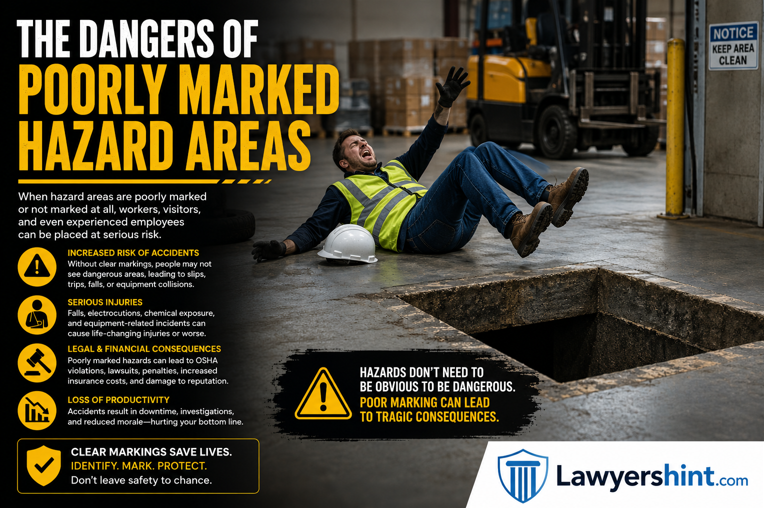

A warning matters most before a person knows they need one. Once a foot lands on a slick floor or a stair gives under pressure, the warning has already failed. The person is no longer choosing a safer route. They are trying not to hit the ground.
That is the problem with a poorly marked hazard. It lets an unsafe space keep speaking the language of ordinary use. The route is open. The light is on. Nothing blocks the way. To most visitors, that means the area is meant to be used. If the property is saying “come through” while the floor, stair, curb, or work area is unsafe, the warning has to interrupt that message before someone commits their weight to it.
Why Warning Placement Matters
Many injury claims turn on a small delay: the warning was there, but not where it needed to be. A cone beside a wet area may satisfy someone looking at the scene later. It may not help the person who approached from another angle or stepped into the slick patch before the cone came into view.
Warning signs have to be read in motion. People do not move through public spaces like inspectors. They follow the path the building gives them, often while carrying something, watching someone else, or thinking about where they are headed. A warning that only works when someone stops, studies the room, and reconstructs the risk is not doing much warning.
The same is true when a sign is vague. “Caution” may tell a person to slow down, but it does not always tell them what to avoid. Is the area closed or merely inconvenient? Is the danger on the floor or beyond the taped-off corner? The more guessing a warning requires, the less protection it gives.
Good marking does not need to turn every mop job into a construction zone. It needs to match the danger. A wet surface needs to be marked before someone reaches it and cleaned quickly. A structural defect may need to be blocked off entirely. A sign can warn. It cannot hold a loose rail in place or make a broken step safe.
The Trouble With Half-Open Spaces
Poor marking often appears when a property is trying to stay open while something is wrong. That is where the danger gets muddled. The route remains available, but it is no longer reliable. A person walking through it has to interpret a scene that should have been made clear for them.
These half-open spaces give mixed messages. The sign suggests caution, but the open route suggests permission. Most people follow the stronger message, and the stronger message is the space itself.
That is why a badly marked hazard can be more dangerous than one that is plainly closed. A locked door is easy to understand. A blocked staircase is clear. A hallway with one cone, poor lighting, and damaged flooring near the wall asks the visitor to make a judgment they may not know they are making.
Lighting can turn a weak warning into no warning at all. A sign in a dim parking garage or a cone placed in a shadow may technically exist without giving real notice. After an injury, the scene may look more obvious under flash photography than it did to the person walking through it. That difference matters.
When Poor Marking Becomes Negligence
Not every fall on someone else’s property creates a legal claim. Floors get wet. Pavement cracks. Repairs happen. The question is whether the person responsible for the property handled the danger reasonably.
A poorly marked hazard may support a claim when the owner, manager, landlord, contractor, or staff knew about the condition and did not take reasonable steps to warn people or keep them away from it. It may also matter whether they should have known. A spill that appeared moments earlier is different from one employees walked past repeatedly. A broken stair reported for weeks is different from damage that happened without warning.
The warning itself may become part of the dispute. A property owner may say a sign was present. The injured person may say the sign was too far away, facing the wrong direction, blocked from view, or placed after the danger rather than before it. Those are not minor details. They go to whether the warning had practical value.
A premises liability lawyer may review photographs, maintenance requests, surveillance video, incident reports, witness statements, and the layout of the area. The goal is not just to prove that someone fell. It is to understand whether the property gave a reasonable warning before the fall happened.
What Injured People Should Document
The scene can change quickly after an accident. Someone may mop the floor, move a cone, fix a light, tighten caution tape, or repair the defect before the injured person has a chance to show what the area looked like.
Photos should show the hazard from the direction the person was walking. A blocked view, poor lighting, a hidden sign, or an open route through a repair area can explain why the danger was not obvious in the moment. Witness names, medical records, incident reports, and written messages with the property owner may also help preserve the timeline.
Insurance companies often focus on personal attention. They may argue that the person should have seen the hazard or should have been more careful. Sometimes that argument ignores how the space actually worked. People rely on property owners to separate open areas from unsafe ones. When the marking is weak, late, hidden, or confusing, the visitor is left to discover the danger physically.
Clear warnings do not make a property perfect. They give people a chance. Poorly marked hazard areas take that chance away when the property looks open and ordinary. If an injury happens because a known danger was not marked or blocked off, a premises liability lawyer can help determine whether the property was managed with reasonable care and provide you with tireless personal injury representation if filing a legal claim is in your best interest.