
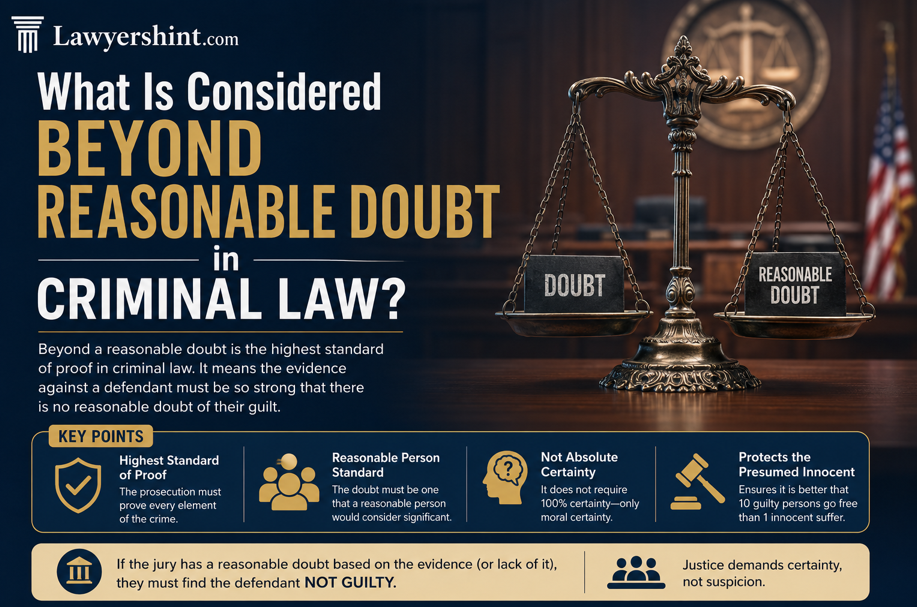

Few phrases have pervaded popular understanding of the criminal law more than “beyond reasonable doubt”. Yet it is also one of the most misunderstood concepts in the legal system.
The following explains what the phrase means, how it operates in court, what kinds of evidence may create reasonable doubt and why this high standard of proof matters.
A Misunderstood Phrase
When a person is charged with an offence, the legal process begins with a fundamental presumption that a person is innocent until proven guilty. .
In Woolmington v DPP [1935] AC 462, the House of Lords described the presumption of innocence as the “golden thread” running through the criminal law.
In practice, this means that the prosecution bears the burden of proving guilt for an offence and the standard they must meet is ‘beyond a reasonable doubt’.
Despite being widely known by the public, the phrase ‘beyond reasonable doubt’ is commonly misunderstood. It is not reducible to mathematical calculation or an extensive test, but is applied using “common sense” criteria.
What Does “Beyond Reasonable Doubt” Mean?
To prove an offence ‘beyond reasonable doubt’, the prosecution must prove each element of the offence to this standard. This includes:
- That the alleged conduct occurred.
- That the accused committed it.
- That any required mental element, such as intention or knowledge, is established.
“Beyond reasonable doubt” does not mean beyond all doubt. In Green v The Queen (1971) 126 CLR 28, the High Court recognised that proof beyond reasonable doubt does not require elimination of every possible doubt, it must be reasonable, not fanciful or speculative.
Judges often direct juries in accessible language, stating that a ‘reasonable doubt’ is a doubt based on reason and common sense and that if they are left with a doubt which they consider to be a reasonable doubt about guilt, the accused must be acquitted.
How It Applies in Court
Criminal matters are heard either summarily in the Magistrates Court or on indictment in the District or Supreme Court.
In summary matters, a magistrate determines whether the prosecution has proved the case beyond reasonable doubt. In most indictable trials which involve juries, jurors collectively assess whether they are satisfied to that standard.
Judges provide directions to juries about how to approach the standard.
Examples of What May Create Reasonable Doubt
Reasonable doubt can arise in many ways, including where witness evidence is unreliable, contradictory or inconsistent; where forensic evidence is unreliable or key evidence is missing to prove every element of the offence.
Doubt may also occur where alternative explanations consistent with innocence have not been excluded by the prosecution. Say for example a person is charged with assault after a fight but the evidence shows several people were involved and no one clearly saw who threw the punch. In this case, there may be a reasonable possibility that someone else caused the injury, and therefore reasonable doubt as to the accused’s guilt.
The High Court in M v The Queen (1994) 181 CLR 487 affirmed that a conviction will be unsafe if it is unreasonable or cannot be supported having regard to the evidence. This reflects the importance of ensuring that the standard has genuinely been met before conviction.
Common Misconceptions
There are a few common misconceptions about the standard of ‘beyond reasonable doubt’.
Some believe that being satisfied beyond reasonable doubt means the judge or jury must be 100% certain that the accused is guilty. However, courts have consistently rejected attempts to express the standard in numerical terms.
Another misconception is that if the accused does not explain themselves, they must be guilty. However, the burden of proof remains with the prosecution to prove an offence to the required standard. In some limited circumstances, certain statutory defences require the accused to meet a certain evidentiary burden, however this is not required to be acquitted from an offence.
Why This Standard Matters
A criminal conviction is one of the most serious things that can happen to a person. Consequences of a conviction can include fines, loss of employment, travel restrictions and lengthy terms of imprisonment.
It’s therefore important that the prosecution has to meet a high standard before criminal consequences will follow.
It’s important to note that criminal proceedings differ from civil proceedings. In civil cases, the standard is “on the balance of probabilities”. That is a lower threshold. It asks whether something is more likely than not. This difference in standard reflects the higher stigma and more serious consequences of a criminal conviction.
A Fundamental Safeguard
The standard of “beyond reasonable doubt” is a fundamental safeguard to personal freedoms. It ensures that no person is convicted unless the prosecution has proven each element of the offence to the required standard.
It does not require absolute certainty. It does not require elimination of every theoretical possibility. But it does require that any remaining doubt be unreasonable before conviction can occur.
Understanding this standard helps explain why many cases result in acquittals, even where the allegations are serious. It explains also why prosecutions can and often do fail.
If you are facing a criminal matter in Western Australia, it is essential to seek guidance from an experienced criminal lawyer who can provide expert advice, protect your rights, and help achieve the best possible outcome for your case.