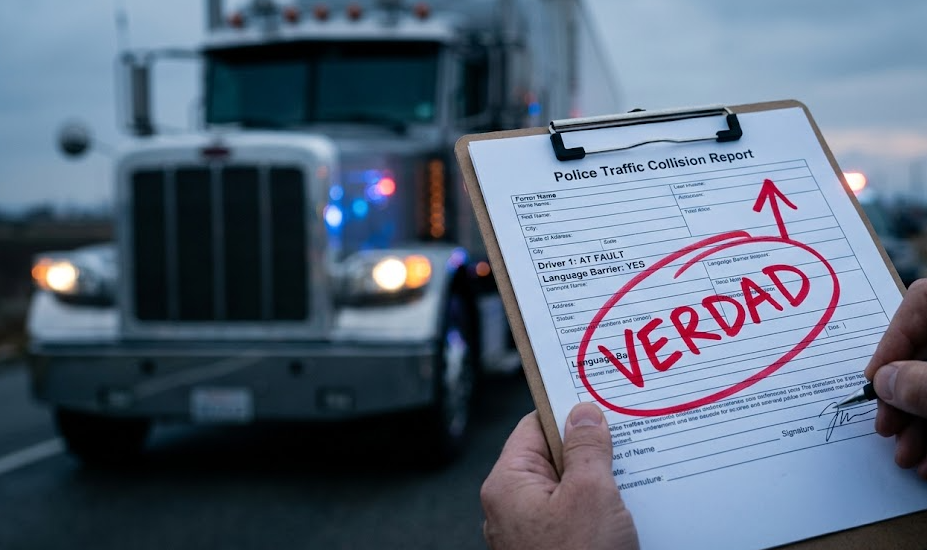

The moments following a collision with a commercial semi-truck on Highway 99 or the I-5 are chaotic. Between the flashing lights, the massive debris field, and the sheer adrenaline of surviving such an impact, clear communication is difficult for anyone. For many residents in the Bakersfield area who speak Spanish as their primary language, this stress is compounded by a significant communication gap. When an English-speaking officer arrives at the scene to document the incident, the nuances of how the crash occurred can easily be lost in translation.
A common misconception among accident victims is that the resulting police report is the final word on who is at fault. If an officer incorrectly identifies you as the party responsible for the crash, you might feel that your chance to recover damages for medical bills or lost wages is gone. However, a police report is a preliminary document, not a judicial ruling. It is possible to challenge the record and prove that the officer’s narrative does not align with the physical facts of the accident.
The Police Report is Not the Final Verdict
In a California civil courtroom, a police report is often viewed differently than the public might expect. Because the officer who writes the report usually did not witness the accident as it happened, their conclusions are technically considered hearsay. They are reconstructing a past event based on the statements of those involved and the positions of the vehicles when they arrived. While insurance companies rely heavily on these reports to make initial settlement offers, the report itself is frequently inadmissible as evidence in a trial.
The officer’s primary goal at the scene is to clear the roadway and ensure public safety, not to conduct a deep-dive forensic investigation into the physics of a commercial vehicle collision. This means that if the officer misinterpreted a statement or failed to account for a mechanical failure in the truck, the report is fundamentally flawed. You have the legal right to contest these findings.
Why Language Barriers Lead to Inaccurate Reports
Kern County is a diverse region, but there is still a noticeable shortage of bilingual officers on patrol at any given time. When a language barrier exists at the scene of a truck accident, officers sometimes rely on “informal” translators. This might be a bystander who happens to speak some Spanish or, in a highly biased move, the truck driver who hit you.
When your side of the story is filtered through an untrained translator, critical details regarding the truck’s speed, its failure to signal, or its sudden lane change can be omitted or twisted. This often leads to a report that paints the Spanish-speaking driver as the negligent party simply because they could not defend their actions effectively at the scene. If you find yourself in this situation, contacting experienced abogados de accidentes de camión en Bakersfield is a vital step toward ensuring your voice is heard and the legal record is corrected. These professionals understand how to bridge the communication gap and present the facts that the responding officer missed.
How to Challenge and Supplement a Faulty Report
If you discover that the police report contains factual errors or leaves out your version of the events, you do not have to remain silent. One of the first steps is to request a supplemental report. While an officer may be reluctant to change their original document, they are often required to attach a supplemental statement from the victim if new evidence is provided.
This is where independent evidence becomes the deciding factor. While an officer’s opinion is subjective, physical data is objective. Most modern commercial trucks are equipped with Electronic Logging Devices and “black box” recorders that track speed, braking patterns, and hours of service. If the data shows the truck was speeding or the driver was over their legal driving limit, it carries far more weight than an officer’s notes from the scene. Additionally, dashcam footage and surveillance video from nearby businesses can provide a literal second-by-second account of the crash that overrides a flawed written report.
The Role of Physical Evidence and Expert Testimony
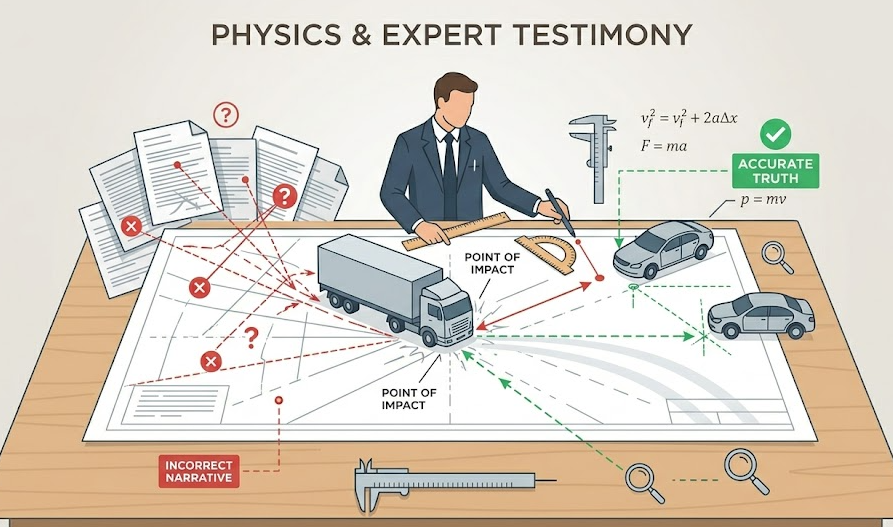
Correcting the record often requires the help of an accident reconstruction expert. These professionals use the laws of physics to determine exactly how a crash occurred. They look at skid marks, the “crush profile” of the vehicles, and the final resting positions of the trucks to determine the points of impact.
An expert can often prove that the accident could not have happened the way the officer described. For instance, if the police report says you cut off the truck, but the physical evidence shows the truck hit you from behind at a high rate of speed, the reconstruction will prove the officer’s narrative was physically impossible. This scientific approach removes the language barrier from the equation entirely, focusing instead on what the evidence reveals.
Moving Forward with Your Claim
A truck accident can change your life in an instant, and the frustration of being blamed for an accident you did not cause only adds to the trauma. It is important to remember that the insurance company for the trucking firm will use a biased police report as a shield to avoid paying what you deserve. They hope that the language barrier and the “official” nature of the report will discourage you from fighting back.
By taking proactive steps to gather evidence and seeking legal guidance, you can set the record straight. A police report is just one piece of a much larger puzzle. With the right investigation, you can prove the truth and secure the compensation necessary for your recovery.