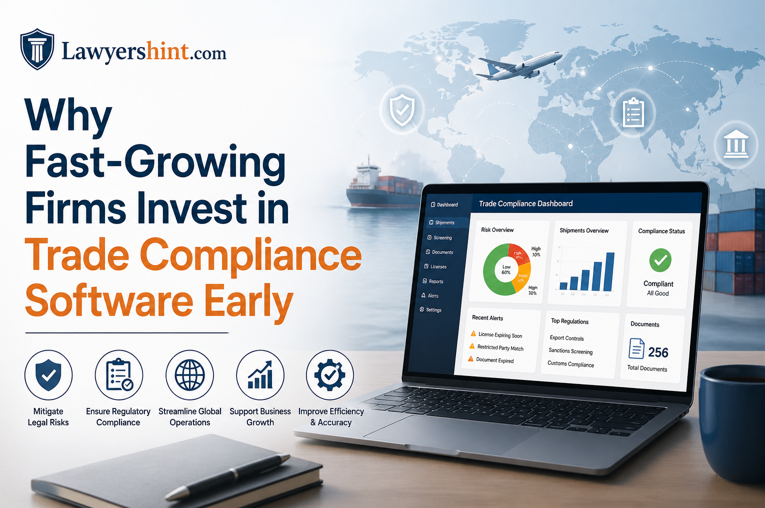

Trade compliance software helps growing companies manage regulations reduce legal risk streamline operations, and ensure smooth global trade now.
- 1. It Prevents Expensive Legal Problems Before They Start
- 2. It Removes the Compliance Bottleneck Before It Forms
- 3. Regulatory Complexity Only Increases as You Grow
- 4. It Captures Cost Savings and Protects Legal Entitlements Early
- 5. It Builds Consistent Standards Across Every Market
- 6. It Gains Better Supply Chain Visibility
- 7. Audits Become Easier to Handle
- Final Thoughts
Are you expanding your business into new international markets and starting to feel compliance straining on your team? Are the processes that once worked smoothly now becoming harder to manage as trade volumes and regulatory requirements increase?
As companies grow, trade compliance becomes more complex, and from a legal perspective, what was once manageable manually can quickly turn into a source of regulatory violations, customs disputes, financial penalties, and contractual liabilities. Trade compliance is not merely an operational concern; it is a legal obligation that directly affects a company’s ability to operate across borders lawfully and efficiently.
Fast-growing companies recognize this early and invest in trade compliance software before these legal and compliance risks escalate. By putting the right systems in place at the right time, they create a stronger legal and operational foundation for growth, allowing them to expand into new markets with greater confidence, consistency, and regulatory control.
Here’s exactly why early investment makes such a significant difference.
1. It Prevents Expensive Legal Problems Before They Start
The best legal strategy is prevention rather than correction. The time to fix a compliance infrastructure is before it breaks, not after. Companies that wait until compliance becomes a visible problem are typically dealing with customs penalties, shipment delays, enforcement notices, strained customer relationships, and increased regulatory scrutiny all at the same time.
Investing early means the systems and compliance controls are already in place when trade volumes spike. Trade compliance software gives fast-growing companies a scalable legal compliance foundation from day one, one that grows with the business rather than becoming a liability at the wrong moment.
Solutions from Livingston International are designed to support that kind of growth, helping businesses manage legal compliance obligations more efficiently as they expand.
2. It Removes the Compliance Bottleneck Before It Forms
Manual compliance processes have a ceiling. At some point, the volume of shipments, jurisdictions, and regulatory requirements exceeds what a manual team can reliably handle. When that ceiling is hit:
- Errors increase as team members rush to keep up
- Timelines slip and shipments get delayed
- Headcount has to grow just to maintain the same output
- Compliance quality drops precisely when legal accuracy matters most
From a legal perspective, errors in tariff classification, restricted party screening, customs declarations, and licensing requirements can trigger direct liability, fines, or even restrictions on future import/export activities.
Software removes that ceiling by automating the tasks that create both operational and legal bottlenecks, tariff classification, documentation preparation, restricted party screening, and regulatory monitoring. Companies that implement it before hitting the manual ceiling scale through it smoothly rather than scrambling to rebuild under legal pressure.
3. Regulatory Complexity Only Increases as You Grow
The more markets a company trades in, the more laws and regulations it must comply with. Tariff schedules change, trade agreements get updated, import restrictions are introduced, and each new market adds its own legal framework on top of everything already in motion.
Failure to comply with one jurisdiction’s customs or trade laws can result in penalties that affect operations across multiple regions.
According to PwC’s Global Compliance Survey 2025, managing compliance manually is no longer practical given the growing volume and complexity of regulatory change, and 49% of businesses are already using technology for eleven or more compliance activities. The earlier automated regulatory monitoring is built into operations, the lower the risk of legal disruption during market expansion.
4. It Captures Cost Savings and Protects Legal Entitlements Early
Free trade agreement savings do not accumulate retroactively, you only capture them on shipments where the right legal documentation was in place at the time. Companies that implement compliance software early start securing these savings from the very beginning of their international growth rather than discovering years later that they have been overpaying duties across multiple markets.
From a legal standpoint, failure to maintain proper origin documentation can permanently eliminate eligibility for preferential tariff treatment and may create disputes during customs audits.
Livingston International’s platform identifies which agreements apply to which products, confirms eligibility, and maintains the documentation needed to claim savings automatically, on every qualifying shipment, consistently, from day one.
5. It Builds Consistent Standards Across Every Market
Fast growth often means entering multiple new markets in a short period of time. Without a standardized compliance system in place, each market tends to develop its own ad hoc approach, different classification methods, different documentation standards, and different screening practices.
These inconsistencies create legal compliance gaps that grow harder to fix over time and become difficult to defend during audits or regulatory investigations.
Companies that implement software early establish consistent standards from the outset:
- The same classification process applied in every market
- The same documentation requirements met across all regions
- The same screening protocols used for every transaction
- A unified compliance approach that scales without legal fragmentation
This consistency is what protects the business when regulatory scrutiny arrives.
6. It Gains Better Supply Chain Visibility
Real-time visibility across a global supply chain is not just a compliance benefit, it is also a major legal and governance advantage. Knowing where shipments are, what their compliance status is, and where potential issues are developing before they escalate allows leadership teams to make better legal and strategic decisions regarding routing, timing, supplier relationships, and market prioritisation.
This is especially important where directors and senior management may be held accountable for inadequate compliance oversight.
Companies that build this visibility early make it part of how they operate, and it compounds in value as the business scales. Those that build it late are often making critical decisions with incomplete legal and operational information at exactly the stage when getting those decisions right matters most.
7. Audits Become Easier to Handle
Growing companies attract increasing regulatory attention. As trade volumes rise, the likelihood of customs audits and compliance reviews increases alongside the complexity of the records that need to be produced.
From a legal perspective, documentation is often the strongest defence. Companies that invest in compliance software early have a complete, organised, and auditable record of every transaction, classification decision, and document submission already in place, maintained automatically as they go.
When an audit arrives, the response is confident and prepared rather than reactive and stressful.
Livingston International’s platform ensures that compliance history is always accurate, complete, and ready to present because it has been building that legal record from the very beginning.
Final Thoughts
Investing in trade compliance software early is not just about adding another system—it is about building the legal and operational foundation that fast growth actually requires.
The companies that do this before they need to scale through complexity smoothly and with stronger legal protection. The ones that wait often invest reactively—after an error, a delay, a customs dispute, or a compliance failure that could have been prevented.
In international trade, getting ahead of compliance is always more cost-effective than catching up with enforcement. Early investment is not simply a business cost—it is one of the smartest legal and strategic growth decisions a scaling business can make.