
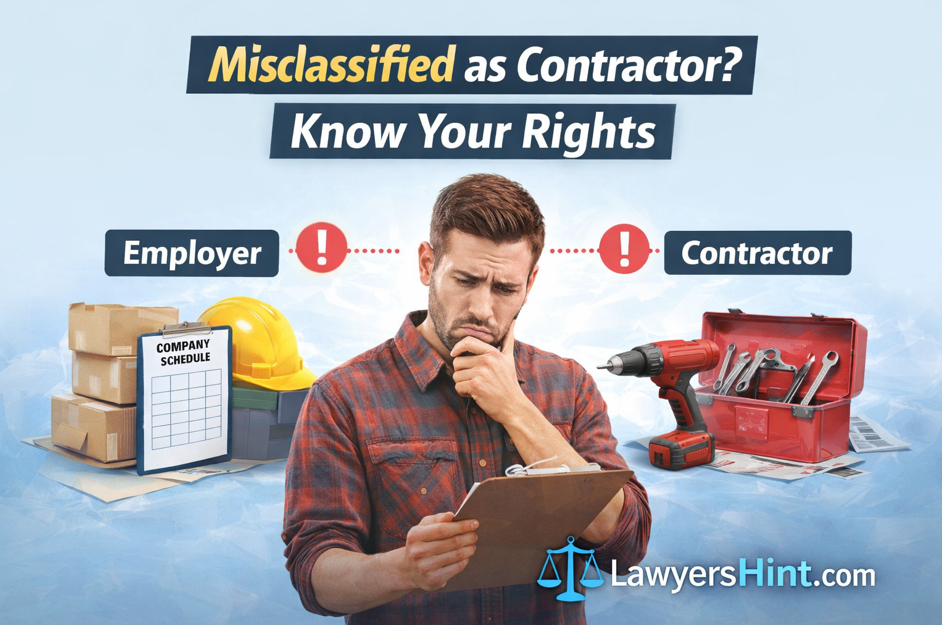

Misclassified as contractor? Learn your rights, spot red flags, and find out how to recover unpaid wages, benefits, and compensation you deserve.
Every year, millions of workers across the country are labeled “independent contractors” by the companies they work for. On the surface, it sounds like a flexible, modern arrangement. But dig a little deeper and a troubling pattern emerges, many of these workers aren’t contractors in any meaningful legal sense. They have set schedules and they use company equipment. They follow company rules and they answer to managers.
If any of this sounds familiar, you may be a victim of employee misclassification, and consulting with an Employee Misclassification Lawyer is the fastest way to find out whether you’re owed compensation you never knew existed. The only thing that’s truly “independent” about many of these arrangements is the label an employer chose to put on a contract, a label that conveniently lets them avoid paying benefits, overtime, taxes, and workers’ compensation.
What Employee Misclassification Actually Means
Misclassification happens when a company deliberately, or sometimes carelessly, categorizes a worker as an independent contractor when that worker should legally be classified as an employee. The distinction matters enormously, because employees are entitled to a wide range of legal protections and benefits that contractors are not. Minimum wage laws, overtime pay, health benefits, unemployment insurance, workers’ compensation, and the right to organize, all of these apply to employees and none of them apply to contractors. When a company misclassifies a worker, they sidestep all of those obligations at once, saving significant money while shifting financial risk and burden onto the worker. It’s a practice that benefits employers greatly and harms workers consistently, which is exactly why labor laws exist to prevent it.
How Courts Actually Determine Your Classification
The job title on your contract is not what determines whether you’re legally an employee or a contractor. Courts and labor agencies use specific legal tests to make that determination, and those tests look at the actual nature of the working relationship rather than what the employer chose to call it. Key factors include how much control the company has over how, when, and where you do your work. They look at whether the work you perform is central to the company’s core business. They consider whether you work exclusively or primarily for one company, whether you use your own tools and equipment, and whether you have the ability to work for competing businesses. In many cases, workers who have been labeled contractors for years discover that they check almost every box for employee status — which means their employer has been violating labor law for the entire duration of their working relationship.
The Financial Impact on Workers Who Are Misclassified
The financial consequences of misclassification are rarely small. When you’re classified as a contractor, you’re responsible for paying both the employer and employee portions of Social Security and Medicare taxes — a burden that employed workers split with their employer. You’re not eligible for employer-sponsored health insurance, retirement contributions, or paid leave. You don’t receive overtime when you work more than 40 hours in a week. You can’t file for unemployment if the company stops using your services. And if you’re injured on the job, you have no workers’ compensation coverage to fall back on. Add all of that up over months or years of working, and the financial harm caused by misclassification can be substantial, often totaling tens of thousands of dollars in unpaid wages, benefits, and tax burdens that were never legally yours to carry.
Signs That You May Have a Misclassification Claim
There are several clear indicators that your classification as a contractor may not hold up under legal scrutiny. If your employer sets your work schedule rather than letting you choose your own hours, that’s a significant red flag. If you’re required to follow company policies, use company-provided tools or software, or work exclusively on company premises, the picture becomes even clearer. If you can’t turn down assignments without consequences, if you don’t set your own rates, or if you’ve been working for the same company in the same capacity for an extended period of time, these are all factors that courts weigh heavily when determining employment status. You don’t need to check every single box to have a viable claim. In many successful cases, a combination of several factors is enough to establish that a misclassification occurred and that the worker is owed compensation as a result.
Why You Need Legal Help to Navigate This
Misclassification claims are not straightforward. They involve overlapping federal and state laws, multiple legal tests depending on the jurisdiction and the type of claim, and employers who almost always have legal teams ready to defend their classification decisions. Trying to navigate this alone puts you at a serious disadvantage from the very start. Working with an experienced employment attorney gives you access to someone who understands exactly how these cases are built, what evidence matters, and how to calculate the full scope of what you’re owed, including back pay, unpaid overtime, tax reimbursements, and potentially penalties against the employer. Legal representation also signals to your employer and their legal team that you’re serious, which often changes the dynamic of any settlement negotiation significantly.
What the Legal Process Looks Like
Most misclassification cases begin with a consultation where an attorney reviews the details of your working relationship and gives you an honest assessment of whether you have a viable claim. From there, the process typically involves gathering documentation, contracts, communications, payment records, schedules, and anything else that reflects how the working relationship actually functioned day to day. Your attorney will identify which legal tests apply to your situation, build the argument for your employee status under those tests, and determine what damages you’re entitled to recover. Some cases resolve through negotiated settlements before ever reaching a courtroom. Others require formal legal proceedings. Either way, having a legal team that specializes in employment law, like the team at Haig B. Kazandjian Lawyers, means you’re not going into the process blind or unprepared.
Don’t Wait Too Long to Act
One of the most important things to understand about misclassification claims is that they are subject to statutes of limitations, legal deadlines that determine how far back your claim can reach and how long you have to file. The longer you wait, the more potential compensation falls outside the window of recovery. If you suspect you’ve been misclassified, the time to act is now, not after you’ve left the company, not after you’ve given it a few more months to see how things go. Every pay period that passes without action is another pay period that may eventually fall outside the reach of your claim. An employment attorney can tell you exactly where you stand and what your timeline looks like, so you can make an informed decision about how to move forward without unnecessary delay.