
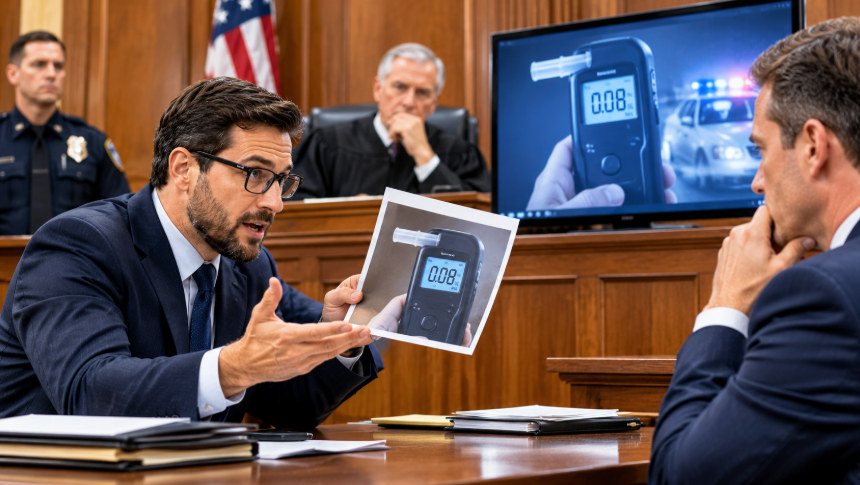

Learn how DWI defense attorneys challenge evidence, question police procedures, protect your rights, and build a strong defense against criminal charges.
Houston, Texas, is a city shaped by constant movement, a busy nightlife scene, and an extensive network of roads connecting its diverse communities. However, its scale also brings serious concerns about impaired driving, with Harris County recording more than 3,300 alcohol-involved crashes and over 12,000 DWI arrests annually. These figures reflect the difficult environment in which law enforcement investigates suspected offenses and prosecutors build cases against accused drivers.
Yet, an arrest does not automatically establish guilt, and every piece of evidence must withstand legal scrutiny. From questioning the reliability of roadside assessments to examining chemical testing procedures and identifying violations of constitutional protections, an effective defense requires attention to detail at every stage. The Houston DWI attorney, Tad Nelson, can help individuals understand their legal options, challenge questionable evidence, and examine whether the state has met its burden of proof before a case reaches its conclusion.
Examining the Initial Traffic Stop
The first question is whether the officer had a lawful reason to stop the vehicle. Erratic driving, a traffic violation, or another observable fact must support the detention under the circumstances. A defense attorney reviews the dash-camera recording, dispatch information, officer notes, and witness accounts to determine whether the stop began lawfully.
A weak reason for the stop can affect everything that follows. If the detention violated constitutional protections, a DWI attorney can assess whether evidence gathered afterward, including statements, test results, or observations made during the encounter, should be excluded.
Challenging Roadside Observations
Field sobriety exercises involve instructions, balance, divided attention, and an officer’s interpretation of performance. Physical conditions, footwear, weather, lighting, medical issues, fatigue, and confusion about instructions can affect the results.
The defense compares the officer’s report with available video and testimony. It also examines whether the officer accurately described each exercise and followed required procedures. Poor performance alone does not establish intoxication, so the state must connect those observations to the legal standard.
Testing the Chemical Evidence
Breath and blood evidence depends on collection, handling, equipment, operator conduct, and laboratory procedures. A defense attorney checks whether the sample was identified correctly, properly preserved, and tested using accepted methods.
The analysis also considers whether the result reflects the driver’s condition while operating the vehicle. A later test does not automatically describe an earlier moment. Timing, test limitations, and gaps in the evidence can create reasonable doubt about what the result proves.
Reviewing Statements and Questioning
Officers often ask questions before, during, and after an arrest. The defense reviews the exact wording, timing, tone, and circumstances surrounding each response. A statement can become less reliable when a person is frightened, confused, injured, or unaware of the legal consequences.
The analysis also covers whether the officer gave required warnings before custodial questioning. If questioning violated constitutional rules, the defense can seek to keep those statements from being used in court.
Contesting Probable Cause for Arrest
An arrest requires more than a hunch. The officer must have facts supporting probable cause that the driver operated a vehicle while intoxicated. The defense measures that conclusion against the complete record rather than accepting a report’s summary.
Conflicting observations matter. A cooperative driver, steady speech, safe vehicle control, or unclear test performance can challenge the state’s interpretation. The defense also checks whether the officer’s account changed between the report, hearing testimony, and recorded video.
Separating License and Criminal Cases
A DWI arrest can create a separate driver-license proceeding alongside the criminal prosecution. Each matter has different procedures, evidence, and consequences. A defense attorney tracks both cases so that decisions in one proceeding do not unnecessarily damage the other.
The license record can also reveal weaknesses in the arrest account. Testimony about warnings, testing, refusal, or the timing of events must remain consistent. Reviewing those details early helps identify issues that Texas rules require immediate attention to.
Challenging the Prosecution’s Trial Proof
At trial, the state must prove every required element beyond a reasonable doubt. The defense tests whether the evidence shows actual operation, intoxication under the applicable definition, and a connection between the alleged impairment and the driving conduct.
Cross-examination can expose missing records, uncertain timelines, unsupported conclusions, or differences between witnesses. A defense attorney also evaluates legal motions, expert testimony, plea proposals, and trial preparation against the evidence rather than relying on the charge alone.
Choosing a Response Based on Evidence
A sound defense decision requires a complete review of the file. That includes video, reports, test records, witness information, medical details, and prior communications. The goal is to identify what the state can prove, what it cannot, and what evidence a judge may exclude.
A person facing a Houston charge can discuss these issues with an attorney,,n after gathering every document received during the arrest. The attorney can then identify procedural defects, preserve objections, and set a strategy suited to the actual record.
Conclusion
A DWI defense does not begin at trial. It starts by testing the legality of the stop and continues through field observations, chemical testing, statements, arrest grounds, license proceedings, and courtroom proof. The next practical step is to preserve every document and recording, avoid discussing the facts publicly, and get a case-specific review before choosing a plea or trial strategy.